
Independence Day Welcome Speech and Vote of Thanks 2026
Ready Lines
Ready Independence Day welcome speech and vote of thanks in English: 2-minute and 30-second versions, fill-in blanks, and whom to thank in what order.

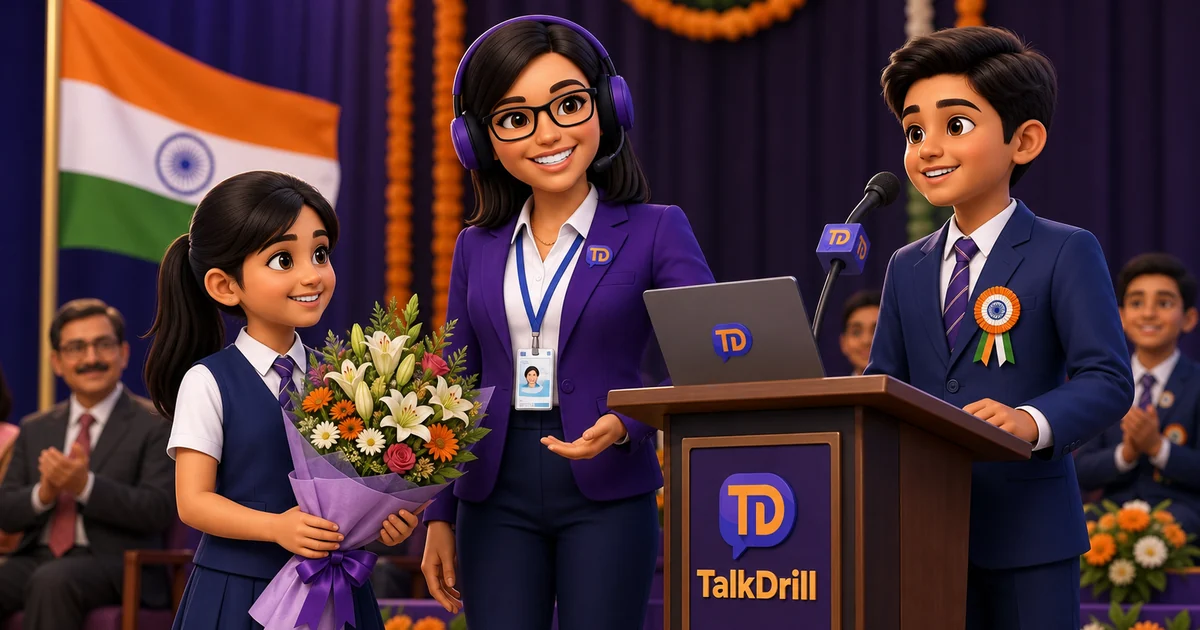
Free: the Independence Day 2026 Speech Pack (PDF)
Twelve printable pages with every speech on this page and more: 1, 2 and 3-minute speeches, a 10-line version, an easy speech for Classes 1 to 5, the welcome speech and vote of thanks, the full anchoring script for the whole function, the five facts students get wrong on stage, and a pronunciation drill for the ten hardest words.
Independence Day Welcome Speech and Vote of Thanks in English
A 15 August school programme has two small speeches that decide how the whole morning feels. The welcome speech at the start sets the tone and makes the guests feel expected rather than merely present. The vote of thanks at the end sends everyone home feeling the morning mattered. Both are short, both are formulaic, and both are usually handed to a student two days before the function.
If that student is you, this guide has what you need. Independence Day 2026 falls on Saturday, 15 August, India's 80th Independence Day. Below you will find a full 2-minute welcome speech and a full 2-minute vote of thanks, both with blanks to fill in, plus 1-minute and 30-second versions for when the programme is running late and a teacher whispers "keep it short".
These two pieces are different from the main Independence Day speech. The main speech is about freedom. These two are about the people in front of you. Get that distinction right and the rest is easy.
Key Takeaways
- The welcome speech comes right after the flag hoisting and anthem. The vote of thanks comes second-last, just before the close.
- A welcome speech names and welcomes people in descending order of seniority: chief guest, principal, teachers, parents, students.
- A vote of thanks reverses nothing and invents nothing. Thank the chief guest first, then the principal, teachers, participants, organisers, and audience.
- Keep both to 2 minutes, roughly 250 to 280 words. Anything longer and you are delaying the programme.
- Write the chief guest's name and designation on your card in large letters and say it aloud ten times before you go on stage.
What Is the Difference Between a Welcome Speech and a Vote of Thanks?
A welcome speech greets people who have just arrived and tells them what is about to happen. A vote of thanks acknowledges people whose work is now finished and tells everyone the programme is ending. One looks forward, the other looks back.
That difference shows up in the tense you use. The welcome speech lives in the future: "we will be witnessing", "you are about to see", "our students have prepared". The vote of thanks lives in the past: "we have just seen", "you gave us your morning", "the students rehearsed for weeks". Students who mix the two up end up thanking people in the welcome speech and welcoming them in the vote of thanks, which sounds odd even to an audience that cannot say why.
The other difference is specificity. A welcome speech can be written a week in advance because it only needs names and designations. A vote of thanks should be finalised on the morning itself, because the best ones mention something that actually happened during the programme.
Where Do These Two Speeches Come in the Programme?
Both sit at fixed points in a standard Indian school Independence Day programme.
| Order | Segment |
|---|---|
| 1 | Assembly and settling |
| 2 | Flag hoisting |
| 3 | National Anthem |
| 4 | Welcome speech |
| 5 | Chief guest's address |
| 6 | Principal's address |
| 7 | Student speeches |
| 8 | Cultural items |
| 9 | Prize distribution |
| 10 | Vote of thanks |
| 11 | Closing and refreshments |
The anchor introduces you in both cases, so you do not need to introduce yourself at length. The full linking lines for the anchor are in our Independence Day anchoring script.
How Do I Write an Independence Day Welcome Speech?
Build it in five blocks, in this order. Each block is one or two sentences.
- Greeting, in descending order of seniority.
- Self-introduction, one line only.
- The occasion, naming the day and the year.
- The welcome proper, where you actually say the word "welcome" to each group.
- The handover, telling the audience what comes next.
The order in block one matters more than students expect. Standard Indian school order is: chief guest, principal, vice-principal, teachers, parents, and finally fellow students. If your chief guest holds a public office, they are greeted first regardless of anything else. If there is no chief guest, the principal comes first.
Two things to avoid. Do not start with a dictionary definition of freedom, because every second speech that morning will do it. And do not list a guest's achievements in the welcome speech; that belongs in the anchor's introduction just before the guest speaks, covered in our guide on how to introduce a chief guest.
Full Independence Day Welcome Speech (2 Minutes)
Roughly 270 words. Fill in the blanks and read it aloud twice before the day.
Respected chief guest __________, our honourable Principal __________ Sir/Ma'am, respected teachers, proud parents, and my dear friends.
A very good morning to all of you, and a very happy Independence Day.
I am __________ of Class ____, and it is my honour to welcome you all to the celebration of India's 80th Independence Day here at __________ School.
Seventy-nine years ago, on the fifteenth of August 1947, this country stopped belonging to somebody else. Ordinary people, many of them no older than the students sitting here, made that happen. Every year on this ground we gather to remember them, and to remind ourselves what they handed us.
On behalf of our entire school, I extend a warm welcome to our chief guest, __________, who has taken time from a busy schedule to be with us this morning. Sir/Ma'am, your presence makes this celebration special for every student here.
I welcome our respected Principal, __________, whose guidance shapes everything that happens in this school.
I welcome our teachers, who have been on this ground since early morning making sure that everything you see today runs smoothly.
I welcome our parents, who are the reason most of us are standing here at all.
And I welcome all my fellow students, who have rehearsed for weeks for the performances you are about to see.
This morning we will have addresses from our chief guest and our Principal, speeches by our students, patriotic songs, and cultural performances prepared by every class.
Thank you all once again for being here. Jai Hind.
Read this speech aloud before you go on stage
Reading a speech silently is not rehearsing it. Read it aloud in TalkDrill and get scored on pace, pauses and pronunciation — so you know which words you stumble on while there is still time to fix them. Free — after signup.
Short Welcome Speech (1 Minute, 10 Lines)
When the programme is already behind schedule, use this. Around 120 words.
Respected chief guest __________, honourable Principal, respected teachers, dear parents and friends, a very good morning and a very happy Independence Day.
I am __________ of Class ____, and I welcome you all to our 80th Independence Day celebration.
Seventy-nine years ago India became free, and ordinary people made that happen.
I extend a warm welcome to our chief guest, __________, for giving us this morning.
I welcome our Principal, our teachers, our parents, and all my friends.
Today we have speeches, songs, and performances prepared by every class.
Thank you for being here. Jai Hind.
How Do I Write an Independence Day Vote of Thanks?
A vote of thanks is a list, but a list that sounds like a person wrote it. Build it in four blocks.
- Opening line that signals the programme is ending.
- The thanks, in order, with one specific detail attached to at least three of them.
- One line of meaning that ties back to the day.
- The close, usually a wish and "Jai Hind".
The detail is what separates a good vote of thanks from a roll call. "Thank you to our chief guest" is a roll call. "Thank you to our chief guest, who told us that freedom is a daily habit and not an annual holiday" is a vote of thanks. You cannot write that line in advance, which is why you finalise this speech during the programme, not before it.
Carry a small card and a pen. While the chief guest speaks, write down one phrase they used. While the cultural items run, note one performance that landed well. Those two notes will carry your whole speech.
Full Independence Day Vote of Thanks (2 Minutes)
Roughly 260 words.
Respected chief guest, honourable Principal, respected teachers, dear parents and my friends.
As our 80th Independence Day celebration comes to a close, I have been given the privilege of thanking everyone who made this morning possible.
First, our heartfelt thanks to our chief guest, __________. Sir/Ma'am, you could have spent this morning anywhere, and you chose to spend it with us. Your words about __________ are something many of us will think about long after today.
Thank you to our respected Principal, __________, for the support that makes celebrations like this possible, and for reminding us every year what this flag actually costs.
Thank you to our teachers. Most of you were on this ground before six o'clock this morning, arranging chairs, checking the sound, and calming down nervous performers. Very little of what you did was visible, and none of this would have happened without it.
Thank you to every student who performed today, especially the __________ of Class ____, which I think the whole ground enjoyed. Weeks of practice went into a few minutes on stage, and it showed.
Thank you to our support staff, who set up this ground and who will quietly put it back together after we leave.
Thank you to our parents for being here, and to every student for sitting through a long morning in the sun with real attention.
Freedom was won once, in 1947. It is kept every day, by ordinary people doing their work properly, which is exactly what this morning has been.
Thank you all, and a very happy Independence Day. Jai Hind.
Short Vote of Thanks (30 Seconds)
Around 70 words, for when the programme has badly overrun.
As we come to the end of our 80th Independence Day celebration, thank you to our chief guest __________ for being with us this morning. Thank you to our Principal, our teachers who have been here since dawn, every student who performed, our support staff, and our parents. Freedom was won once. It is kept every day. Happy Independence Day to all of you. Jai Hind.
Whom Do You Thank, and in What Order?
Use this order unless your school has its own convention. Skip anyone who was not present rather than inventing a mention.
| Order | Whom | Typical detail to attach |
|---|---|---|
| 1 | Chief guest | Something specific they said |
| 2 | Principal | Support, or a line from their address |
| 3 | Vice-principal and senior staff | Only if they had a visible role |
| 4 | Teachers | Early-morning setup, rehearsals |
| 5 | Student performers | Name one item that landed well |
| 6 | Anchors and organisers | Only in longer versions |
| 7 | Support and ground staff | Setup and clearing |
| 8 | Parents | Attendance |
| 9 | Fellow students | Attention through a long morning |
Two mistakes to avoid. Do not thank the same person twice in different roles, which happens when the principal is also the chief guest's host. And never end on a name; end on the meaning line and the wish, so the last thing the ground hears is about the day, not about a person.
Phrase Bank
Swap these in so your speech does not sound like everyone else's.
Welcome openings
- "A very good morning, and a very happy Independence Day to each one of you."
- "On behalf of the students and staff of __________ School, welcome to our 80th Independence Day celebration."
- "It is a proud morning for all of us, and I am glad you are here to share it."
Welcoming the chief guest
- "Sir/Ma'am, your presence this morning means a great deal to every student on this ground."
- "We are grateful you chose to spend this Independence Day morning with us."
- "Thank you for accepting our invitation, and a very warm welcome to you."
Thanks openings
- "Every celebration ends with gratitude, and this one has a long list."
- "As this morning comes to a close, allow me to thank the people behind it."
- "A programme like this looks effortless only because a lot of people worked hard."
Closing lines
- "Freedom was won once, in 1947. It is kept every day, by people like us."
- "May we carry a little of this morning into the rest of the year."
- "Happy Independence Day, and thank you once again. Jai Hind."
Delivery Tips That Matter on the Day
- Say the chief guest's name ten times before you go on stage. Names are where students stumble, and it is the one mistake the guest personally notices.
- Write in large letters on a card. Outdoor functions have wind and sun glare, and a phone screen washes out completely.
- Slow down by about a quarter. Nervous speakers run fast. If your practice run takes 2 minutes, your stage run will take 90 seconds unless you deliberately slow down.
- Look up at the end of each block. Five blocks, five moments of eye contact. That is enough to look confident without losing your place.
- Rehearse aloud, standing. Reading it silently in your head does not prepare your mouth for the words. Repeated reading aloud is what builds fluency and expression, and it is the single highest-return thing you can do the night before.
You can paste either speech into TalkDrill's Read Aloud practice (free with an account), read it aloud, and get scored on fluency and pronunciation, which is useful for exactly the two things that go wrong on stage.
Frequently Asked Questions
How long should an Independence Day welcome speech be?
Two minutes, roughly 250 to 280 words. A welcome speech is a doorway, not a room. If the programme is running late, use the 1-minute version above, which keeps the full greeting order but drops the elaboration.
Who should give the vote of thanks on Independence Day?
Usually a senior student, often the head boy, head girl, or a Class 11 or 12 student, and sometimes a teacher. The person should have been present for the whole programme, because a good vote of thanks refers to things that actually happened during it.
Can I use the same speech every year?
The structure, yes. The content, no. Names, designations, the year, and the count all change, and 2026 is the 80th Independence Day marking 79 completed years. Reusing last year's speech with the old number is the most common error at school functions.
What if I forget a name on stage?
Do not stop and apologise at length. Say "and to everyone who worked behind the scenes this morning" and keep moving. Audiences forgive a smooth omission far more easily than a long, flustered correction.
Should the welcome speech mention the freedom fighters?
One line is enough, and it works better than a list. The main Independence Day speech is where history belongs; our Independence Day speech in English covers that in 1, 2 and 3-minute versions. In a welcome speech, one sentence about 1947 gives the day its weight without competing with the speakers who follow you.
Can I give the vote of thanks in Hindi?
Yes, and in many schools a bilingual close works beautifully. A common pattern is to deliver the thanks in English and the final two lines in Hindi. Our 15 August speech in Hindi and English has bilingual lines you can adapt.
Bringing It Together
The welcome speech and the vote of thanks are the bookends of your Independence Day programme. Neither needs to be clever. Both need to be correct, warm, and short.
Fill in the blanks in the versions above, check every name and designation with your teacher-in-charge, and carry a written card. During the programme, jot down one phrase from the chief guest's address and one performance that went well, then work both into the vote of thanks. That single habit turns a list into a speech.
If you are handling more of the programme than these two pieces, the full Independence Day anchoring script covers every link from the flag hoisting to the closing. For general-purpose versions you can reuse at other functions, see our welcome speech in English and vote of thanks speech in English guides.
Happy Independence Day, and speak slowly.
Meghanand Kumar
Strategic Advisor
Strategy and AI/hardware advisor. MS, Université Paris-Saclay.
Turn anything you read into speaking practice
Install the free TalkDrill Chrome extension: highlight any sentence on any website or YouTube video, say it aloud, and get an instant pronunciation score with word-by-word feedback.
Related Articles
Continue reading more from TalkDrill Blog
Stay Updated with TalkDrill
Get the latest English learning tips and AI insights delivered to your inbox.