
Children's Day Anchoring Script in English 2026
Full Programme
A complete Children's Day anchoring script in English for school: welcome, tribute to Nehru, speeches, the teachers' performance, games and vote of thanks.

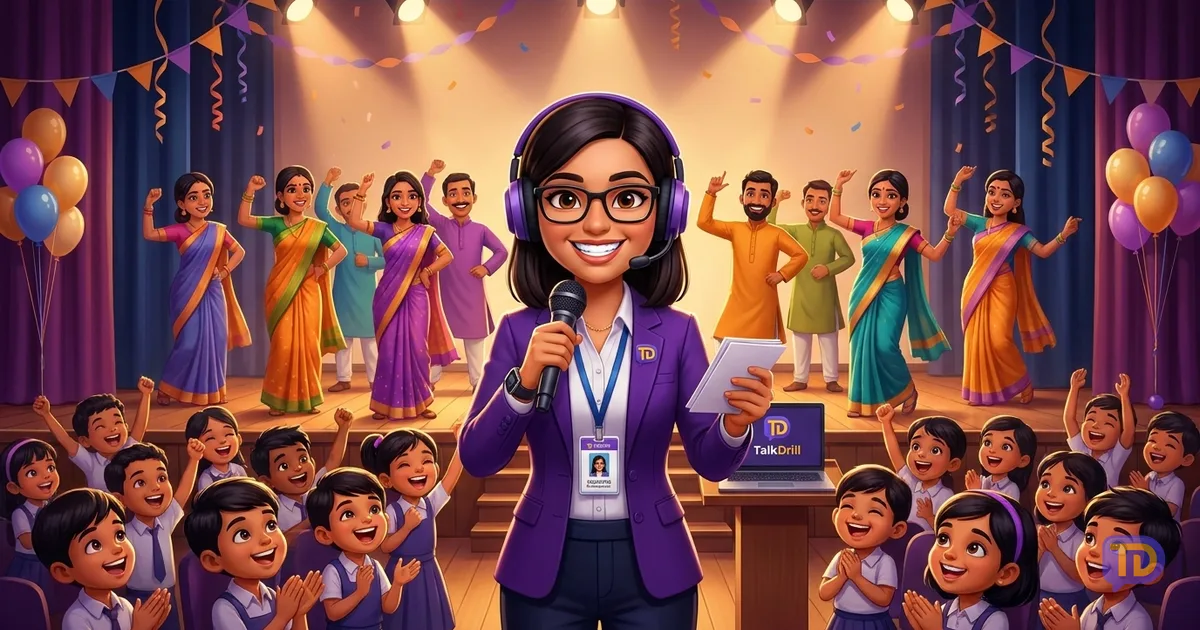
Children's Day Anchoring Script in English 2026 (Full Programme)
Here is a complete Children's Day anchoring script you can run the whole 14 November programme from: welcome, prayer or lamp lighting, the tribute to Pandit Nehru, the principal's address, a student speech, the teachers' performances, students' items, games and sweets, vote of thanks and closing. Fill-in lines are marked wherever a name or a class goes.
Children's Day has one feature most school functions do not: in many schools the teachers perform and the students are the audience. The script works whether a student or a teacher is holding the microphone, and gives alternative lines where it matters.
Before the day
- Date: Saturday, 14 November 2026. If your school is closed on Saturdays, the programme will usually be on Friday, 13 November.
- Anything in [square brackets] is a blank. Fill it in before the day.
- Print the script in a large font, and keep a pen with you. The order will change ten minutes before you start.
- Get the list of teachers' items in writing from the teacher in charge. That is the part most likely to be a surprise, sometimes even to you.
Sample running order (about 75 minutes)
| # | Item | Time |
|---|---|---|
| 1 | Welcome and why 14 November | 3 min |
| 2 | Prayer or lamp lighting | 5 min |
| 3 | Tribute to Pandit Nehru | 5 min |
| 4 | Principal's address | 5 min |
| 5 | Student speech | 3 min |
| 6 | Teachers' performances | 20 min |
| 7 | Students' cultural items | 20 min |
| 8 | Games announcement and sweets | 7 min |
| 9 | Vote of thanks | 3 min |
| 10 | Closing and National Anthem | 4 min |
Short of time? Cut student items first, then shorten the teachers' slot. Never cut the tribute or the vote of thanks.
The numbered sections below follow the running order, so section 6 in the script is item 6 in the table.
1. Welcome and why 14 November
Good morning, everyone!
Respected Principal [name], our dear teachers, and the real guests of honour today, all the students of [school name]: a very warm welcome to you.
Today is the fourteenth of November, Children's Day. For one morning, the rules are a little different. The front rows belong to students, and the stage belongs to the people who usually stand at the front of our classrooms.
I am [your name] of Class [class], and it is my pleasure to host this morning's celebration.
If a teacher is anchoring, use this welcome instead:
Good morning, children! Today nobody will ask for your homework, and nobody will tell you to sit up straight. Today is Children's Day, and this morning is entirely yours. I am [name], and I will be your host.
Then say why the day falls on 14 November, in two or three sentences only. The student speaker will cover Nehru's life; your job is to set it up.
We celebrate Children's Day on the fourteenth of November because it is the birthday of Pandit Jawaharlal Nehru, the first Prime Minister of India, born in 1889. He loved the company of children, and they called him Chacha Nehru.
This year is his one hundred and thirty-seventh birth anniversary.
2. Prayer or lamp lighting
Let us begin our celebration with a prayer. May I request [the school choir / Class (x)] to come forward. Everyone, please rise.
[After the prayer] Thank you. Please be seated.
If your school lights a lamp instead:
I now request our respected Principal [name] to light the lamp and formally open our Children's Day celebration.
Read this speech aloud before you go on stage
Reading a speech silently is not rehearsing it. Read it aloud in TalkDrill and get scored on pace, pauses and pronunciation — so you know which words you stumble on while there is still time to fix them. Free — after signup.
3. Tribute to Pandit Nehru
A birthday needs a tribute. May I request our Principal, along with [the head boy and head girl / two of our youngest students], to offer flowers at the portrait of Pandit Jawaharlal Nehru.
[While they do it] Pandit Nehru usually wore a rose on his coat. The flowers at his portrait this morning are our way of returning the gesture.
4. The Principal's address
Every child in this school is, in a way, the Principal's child. May I invite our respected Principal, [name], to say a few words to all of us. A big round of applause, please.
[After] Thank you, ma'am / sir. [Repeat one thing they said, in your own words. It shows you were listening, and it is what separates a good anchor from someone reading a page.]
If the Principal would like something ready to read, there is a short principal's speech for Children's Day that takes just over a minute.
5. Student speech
Who better to speak about Children's Day than one of us? May I invite [name] of Class [class] to share a few words about Chacha Nehru and what this day means.
[After] Thank you, [name]. That was lovely.
If a speaker freezes, walk over, stand beside them and say quietly, "Take your time. We are all with you." They usually carry on. If they cannot, take the microphone gently, say "Thank you, [name], for that," and call the next item. Never let a child walk off in silence.
6. The teachers' performances
This is the part everyone has been waiting for. Build it up.
And now, the moment you have all been waiting for. On every other day of the year, our teachers watch us perform. Today, the tables have turned.
Song: Please welcome [teachers' names] with a song they have been secretly practising for weeks.
Dance: Next, a dance by our teachers. Students, you are allowed to cheer as loudly as you like. Teachers, we promise not to give you marks.
Skit: Our teachers have prepared a skit about a typical day in our school. Any resemblance to real students is, I am told, completely intentional.
If a teacher is anchoring: "My colleagues have rehearsed this after school for two weeks. Please be kind. Actually, no, please be loud."
7. Students' cultural items
Group song: Let us welcome the students of Class [class] with a song.
Dance: Put your hands together for [names] of Class [class].
Poem: May I invite [name] of Class [class] to recite a poem.
Fancy dress (for the youngest classes): And now our littlest stars, the students of [Nursery / Class 1], in their fancy dress parade. Please give them your biggest applause of the morning.
8. Games, fun fair and sweets
The celebration does not end in this hall. [The games / the fun fair / the film screening] will begin at [time] in [place]. Class teachers will take you there class by class.
Before you go home, every student will receive [sweets / a small gift] from our teachers. Please collect it in your classroom.
9. Vote of thanks
A good celebration needs a good thank you. May I invite [name] of Class [class] to deliver the vote of thanks.
If you are delivering it yourself:
On behalf of all the students, thank you to our respected Principal for giving us this day. Thank you to our teachers, who rehearsed, sang, danced and acted for us, and were brave enough to do it in front of the whole school. Thank you to every student who performed, and to the staff who set up the stage, the sound and the chairs. Most of all, thank you to all of you for being such a wonderful audience.
10. Closing and National Anthem
And with that, we come to the end of our Children's Day programme.
Pandit Nehru believed that the children of a country decide its future. Looking at this hall today, I think the future is in good hands, and in very loud ones.
Before we leave, may I request everyone to stand for the National Anthem.
[After the anthem] Thank you, and Happy Children's Day!
Anchoring lines to keep in your pocket
Every programme has a gap. Have these ready so you never fill one with silence:
- "While the next performers get ready, a quick question for the audience: which teacher do you think will dance best? Hands up!"
- "A big round of applause for the sound and stage team, who have been here since early this morning."
- "We have a small change in the programme. That is what makes it a live show."
- "Let us hear that applause once more. I do not think the teachers at the back heard you."
If the youngest classes are performing too, the 10 lines on Children's Day are short enough for a Class 1 child to say on stage, and they fit neatly into the students' items in section 7.
Frequently Asked Questions
Who should anchor the Children's Day programme?
Either a teacher or a senior student. Many schools let teachers anchor because the day is meant for students; others choose students to keep it lively. The script above gives alternative lines for a teacher.
How long should a Children's Day programme be?
Most school programmes run 45 to 90 minutes. The running order above is about 75 minutes. If you are short of time, cut student items first and keep the tribute and the vote of thanks.
What do teachers usually perform on Children's Day?
Songs, group dances and skits are the most common, often with gentle humour about school life. Ask the teacher in charge for the list a day early so you can introduce each item properly.
Should the anchor talk about Nehru's life?
Only briefly, in two or three sentences at the start. Leave the biography to the student speaker; repeating it is the most common anchoring mistake.
What if our programme is on 13 November?
Change the opening to say that tomorrow is the fourteenth of November, Children's Day. Everything else stays the same.
Meghanand Kumar
Strategic Advisor
Strategy and AI/hardware advisor. MS, Université Paris-Saclay.
Turn anything you read into speaking practice
Install the free TalkDrill Chrome extension: highlight any sentence on any website or YouTube video, say it aloud, and get an instant pronunciation score with word-by-word feedback.
Related Articles
Continue reading more from TalkDrill Blog
Stay Updated with TalkDrill
Get the latest English learning tips and AI insights delivered to your inbox.