
English Roleplay Practice: Conversations You Will Actually Have
Structured speaking scenarios with a part to play and someone on the other side of the conversation — shop counters, salary talks, formal debates and case interviews.
Free to start. You need a TalkDrill account to speak — reading this page does not.
Most English practice fails at the same point: you can say what you planned, and then the other person says something you did not plan for. Roleplay exists for that second half. Every scenario here gives you a part to play, a counterpart with their own agenda, and a conversation that does not go the way you rehearsed it.
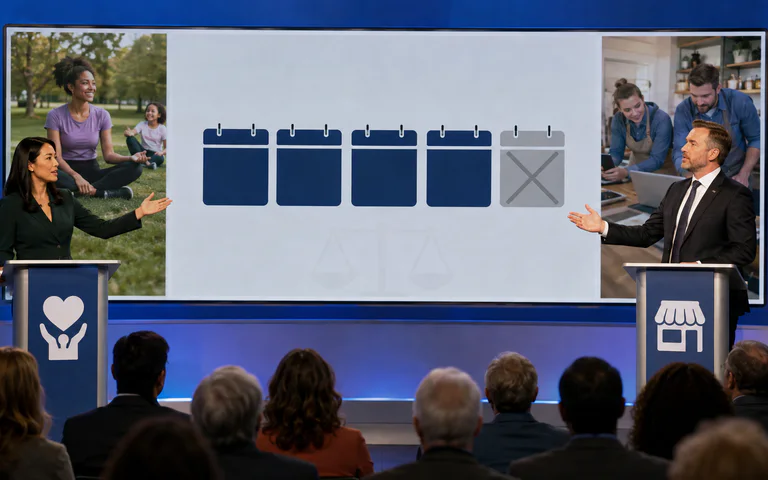
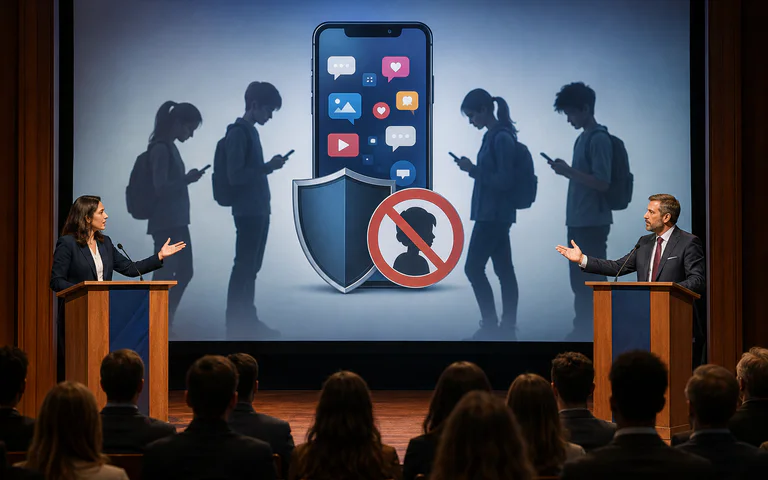
The scenarios split into two families. The everyday ones — returning a faulty product, changing a booking, asking a manager for time off — are the situations where fluent-on-paper speakers freeze, because the vocabulary is easy and the pressure is social. The structured ones — formal debates and case-study rounds — are the opposite: the pressure is intellectual, you hold a position, and someone presses on the weakest part of it for three rounds.
You always know your own brief before you start: who you are, what you want out of the conversation, and the phrases worth reaching for. You do not know what the other side will do with it, and that is deliberate. The report afterwards covers whether you got what you came for, how you handled the turn you did not expect, and how your delivery held up once the conversation stopped being comfortable.
How a roleplay session works
Read your brief
Your role, the situation, and what a good outcome looks like. The counterpart has their own brief, and you do not get to read it.
Open the conversation
You speak first in most scenarios. How you open sets what you can ask for later, which is most of the exercise.
Handle the turn
Somewhere in the middle it stops going your way — a refusal, a counter-offer, a rebuttal you did not prepare for. That moment is the scenario.
Read the report
Outcome, the phrases you used and the ones you missed, fluency and clarity, and the specific line worth rewriting.
Every roleplay scenario in the catalogue
Work



Daily Life





Travel




Placement







Case Study






Debate




What you're scored on
Across every roleplay, the report looks at the same four things — because they are what makes a real conversation work or fail.
Task outcome
Whether you got what the brief asked for: the refund, the extension, the concession, the point conceded.
Appropriacy
Whether the register fits. A complaint that is too soft gets nothing; the same complaint too hard gets a manager and no refund.
Recovery
What you do with the unexpected turn — repair, rephrase, push back, or stall. This is where most of the marks move.
Delivery
Fluency, pronunciation and pace, judged in conversation rather than in a prepared monologue.
Roleplay practice — common questions
What is roleplay practice in English?
You take a defined part in a defined situation — customer, candidate, colleague, speaker defending a motion — and speak through it with someone playing the other side. It moves practice off memorised sentences and on to the thing sentences are for: getting an outcome from another person.
Do I need to prepare before starting a scenario?
No. The brief is on the page, and reading it is the preparation. Scanning the target phrases first helps, because those are the expressions the scenario is built to make you reach for.
What is the difference between a debate and a case study here?
In a debate you are handed a position and must defend it across timed rebuttal rounds against an opponent arguing the other side. In a case study you are handed a business situation, asked for a decision, and then questioned on it — there is no fixed right answer, only a defensible one.
Can I do the same scenario more than once?
Yes, and the second run is usually the useful one. The counterpart does not follow a script, so the conversation diverges — which is exactly what stops repetition turning into recitation.
Is this useful if my grammar is weak?
Yes. Start with the everyday scenarios at beginner level, where the situation carries the vocabulary for you. The report separates what you got wrong from what got in the way of being understood, and those are rarely the same list.