
Independence Day Speech for Kids: Easy Speeches for Class 1 to 5
Easy Independence Day speeches for Classes 1 to 5: an 8-line version for little ones, a 15-line one for juniors, hard words explained, plus simple stage tips.

Free: the Independence Day 2026 Speech Pack (PDF)
Twelve printable pages with every speech on this page and more: 1, 2 and 3-minute speeches, a 10-line version, an easy speech for Classes 1 to 5, the welcome speech and vote of thanks, the full anchoring script for the whole function, the five facts students get wrong on stage, and a pronunciation drill for the ten hardest words.
Independence Day Speech for Kids: Easy Speeches for Class 1 to 5
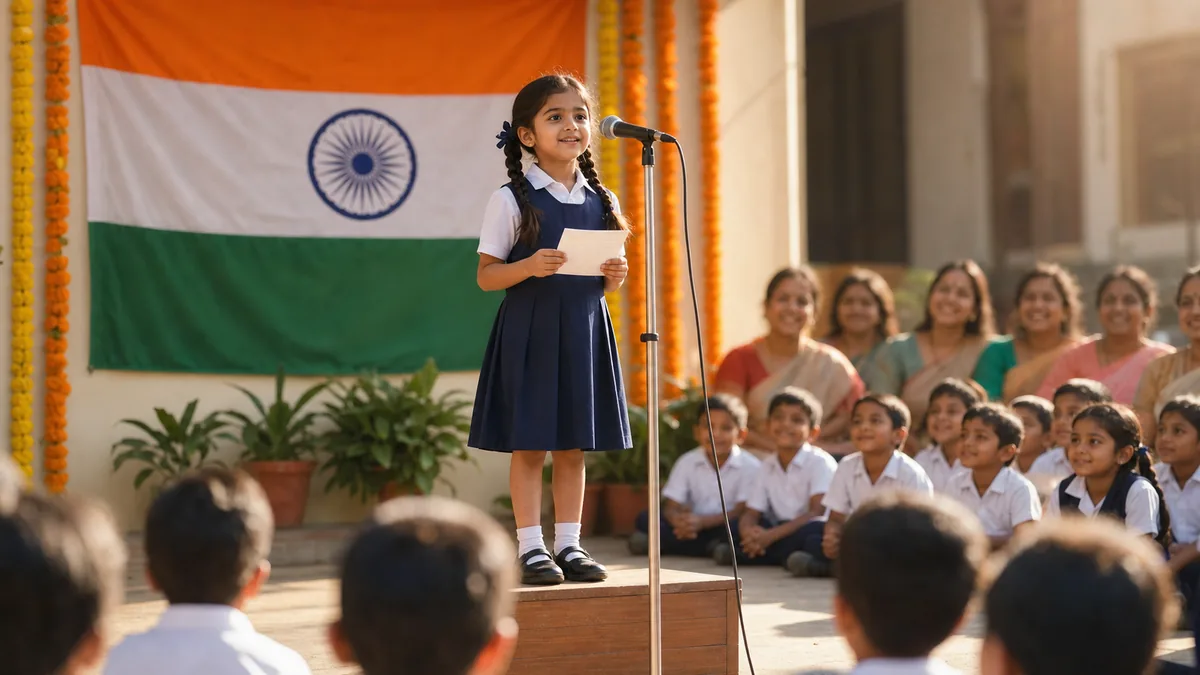
A small child does not need a long speech. They need a short one they can actually remember, in words they already use, that they can say loudly without running out of breath. That is the whole job.
Below are two ready speeches — an 8-line version for Classes 1 and 2, and a 15-line version for Classes 3 to 5 — plus the two or three hard words explained, and the rehearsal method that actually works the night before.
What makes a good speech for a young child
Before the scripts, three things worth knowing, because they change what you should pick:
- One idea per line. A child who has to hold two ideas in one sentence will lose both. Short lines are not a compromise — for this age they are the correct format.
- One breath per line. If your child cannot say a line in a single comfortable breath, the line is too long. Cut it, do not make them practise harder.
- Big numbers and hard names are where children stumble. "Nineteen forty-seven" is fine. A list of five freedom fighters is not. Pick one or two names, no more.
Independence Day speech for Class 1 and 2 (8 lines)
About 30 seconds. Simple words only, nothing to trip over.
Good morning everyone.
My name is ______.
Today is the fifteenth of August.
It is our Independence Day.
On this day, our country India became free.
Our flag has three colours — orange, white and green.
I love my country very much.
Happy Independence Day. Jai Hind!
If your child is confident and you want a little more, add these two lines before the last one:
Many brave people fought so that we could be free.
We say thank you to them today.
Independence Day speech for Class 3, 4 and 5 (15 lines)
About one minute. Still simple, but with a little history and a proper ending.
Respected teachers and my dear friends,
Good morning to all of you.
My name is ______ and I study in Class ______.
Today we are celebrating Independence Day.
On the fifteenth of August, 1947, India became a free country.
Before that day, the British ruled our land for many years.
Our freedom fighters worked very hard to make India free.
Mahatma Gandhi taught us to be truthful and peaceful.
Many brave people gave their lives for our country.
That is why we salute our flag today.
Our flag has three colours and a blue wheel in the middle.
The wheel reminds us to keep moving forward.
We must study well and keep our country clean.
That is the best way to say thank you to our freedom fighters.
Happy Independence Day. Jai Hind!
Read this speech aloud before you go on stage
Reading a speech silently is not rehearsing it. Read it aloud in TalkDrill and get scored on pace, pauses and pronunciation — so you know which words you stumble on while there is still time to fix them. Free — after signup.
The hard words, explained simply
These are the words children usually stumble on. Practise just these, not the whole speech, and the rest becomes easy.
- Independence — say it as in-di-PEN-dence, four beats, stress on the third. It means being free, and not being ruled by someone else.
- Celebrating — SE-le-bray-ting. Children often say "cel-BRAY-ting" and lose a beat.
- Freedom fighters — the brave people who worked to make India free.
- Salute — sa-LOOT. To show respect, often by raising your hand to your forehead.
- Tricolour — another name for our flag, because it has three colours.
How to rehearse the night before
Do not ask a child to "learn the speech". Ask them to do this instead:
- You read one line. They repeat it. Go through the whole speech twice this way. No memorising yet — just the sound of it.
- Clap once at every full stop. This teaches the pause, which is what makes a small child sound confident rather than rushed. Nervous children speak fast; the clap fixes it without you having to say "slow down" ten times.
- Say it standing up, looking at a wall. Sitting down and standing up are different physical experiences. Practise the one they will actually do.
- Last run: you stand at the back of the room. They have to be loud enough for you to hear. That is the only volume training they need.
Four short rounds beats one long session. If a child gets one line wrong on stage, nobody in the audience will know — but they will notice a child who looks up and smiles.
Stage tips for the day
- Stand still. Feet slightly apart, hands by the side or lightly held in front. Rocking side to side is the most common nervous habit at this age.
- Start only after you have looked up once. Reach the mic, take one breath, look up, then begin. It buys three seconds and settles the nerves.
- Loud is more important than perfect. A child who says eight lines clearly and audibly will be remembered better than one who whispers fifteen.
- End with the hands. "Jai Hind" with a small salute gives a clear ending, so the audience knows when to clap. Children often walk off in silence because nobody realised they had finished.
Which version should my child use?
| Class | Length | Use this |
|---|---|---|
| Class 1–2 | ~30 seconds | The 8-line speech above |
| Class 3–5 | ~1 minute | The 15-line speech above |
| Class 6–8 | ~2 minutes | The 2-minute speech |
| Class 9–12 | ~3 minutes | The full 3-minute speech |
Frequently asked questions
How long should an Independence Day speech for kids be?
For Classes 1 and 2, about 30 seconds — roughly 8 short lines. For Classes 3 to 5, about a minute, or 15 lines. Anything longer is usually the parent's ambition rather than the child's comfort.
What should a child say at the end of the speech?
"Happy Independence Day. Jai Hind!" It is short, everyone recognises it, and it signals clearly that the speech is over so the audience knows to clap.
My child forgets lines on stage. What can I do?
Shorten the speech rather than rehearsing more. A confident 8-line speech is better than a shaky 15-line one. Also teach them one recovery line — "Once again," — so a blank moment sounds deliberate instead of frightening.
Which freedom fighters should a young child mention?
One or two, not a list. Mahatma Gandhi is the safest for young children because the idea attached to him — truth and peace — is easy for them to explain if a teacher asks a follow-up question.
Is 15 August 2026 the 79th or 80th Independence Day?
The 80th. It marks 79 completed years of freedom. Here is why both numbers are right.
For older students, use the speeches for Class 6 to 10, the full Independence Day speech in English, or the 2-minute version. Anchoring the assembly? Here is the complete Independence Day anchoring script.
Meghanand Kumar
Strategic Advisor
Strategy and AI/hardware advisor. MS, Université Paris-Saclay.
Turn anything you read into speaking practice
Install the free TalkDrill Chrome extension: highlight any sentence on any website or YouTube video, say it aloud, and get an instant pronunciation score with word-by-word feedback.
Related Articles
Continue reading more from TalkDrill Blog
Stay Updated with TalkDrill
Get the latest English learning tips and AI insights delivered to your inbox.