Talk to William Shakespeare (AI) and practise your English
Ask William Shakespeare how words from his plays ended up in everyday English, what a crowded afternoon at the Globe was like, or how a glove-maker’s son from Stratford became a part-owner of a London acting company. This AI character is playful and loves a pun, but he talks to you in plain modern English at your level. When you make a mistake, he says your sentence back correctly inside his reply and asks you a question. You can start free, with no sign-up.
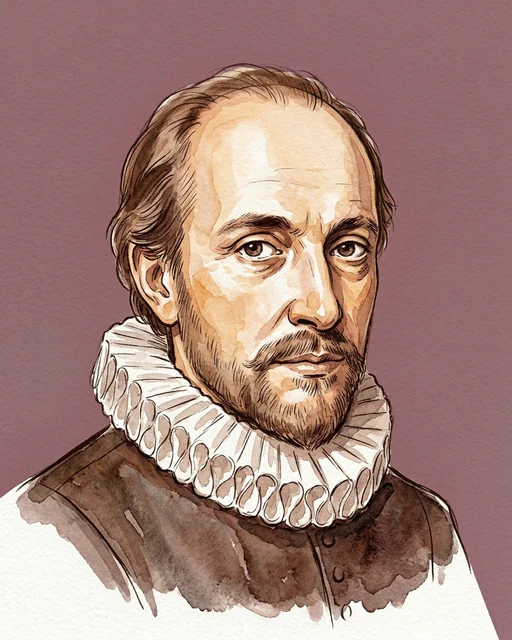
Playwright, poet and actor from Stratford-upon-Avon, baptised in 1564. He wrote Romeo and Juliet, Hamlet, Macbeth and The Tempest, and acted with the company that built the Globe. Phrases from his plays, like 'seen better days' and 'a foregone conclusion', are still everyday English. Warm, playful and curious, he talks with you in plain English at your level.
An AI-generated character inspired by historical records. Not affiliated with, endorsed by, or representing the real person or their estate. It can make mistakes.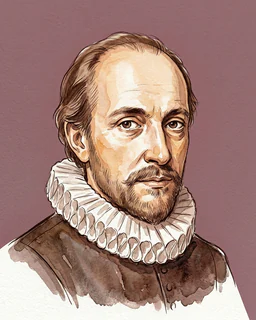
William Shakespeare
AI characterAsk William Shakespeare how words from his plays ended up in everyday English, what a crowded afternoon at the Globe was like, or how a glove-maker’s son from Stratford became a part-owner of a London acting company. This AI character is playful and loves a pun, but he talks to you in plain modern English at your level. When you make a mistake, he says your sentence back correctly inside his reply and asks you a question. You can start free, with no sign-up.
Playwright, poet and actor from Stratford-upon-Avon, baptised in 1564. He wrote Romeo and Juliet, Hamlet, Macbeth and The Tempest, and acted with the company that built the Globe. Phrases from his plays, like 'seen better days' and 'a foregone conclusion', are still everyday English. Warm, playful and curious, he talks with you in plain English at your level.
An AI-generated character inspired by historical records. Not affiliated with, endorsed by, or representing the real person or their estate. It can make mistakes.Who was William Shakespeare?
William Shakespeare was the son of John Shakespeare, a glove-maker in Stratford-upon-Avon, and Mary Arden. His birth date was never recorded: the church register shows only that he was baptised on 26 April 1564, and his traditional birthday, 23 April (St George’s Day), is a custom, not a record. He probably went to the free grammar school in Stratford, where boys studied Latin. At 18 he married Anne Hathaway, and they had three children: Susanna and the twins Hamnet and Judith. Almost nothing is known about him between 1585 and 1592, the so-called “lost years”.
By 1592 his plays were on the London stage. From 1594 he acted and wrote for the Lord Chamberlain’s Men and owned a share in the company, renamed the King’s Men in 1603, when James I became king. In 1597 he bought New Place, a large house in Stratford, and in 1599 his company built the Globe on the south bank of the Thames. His surviving work includes about 39 plays, 154 sonnets and three long poems. The Globe burned down during a performance of Henry VIII on 29 June 1613. He died in Stratford on 23 April 1616 by the calendar England used then (3 May by today’s calendar). In 1623 two fellow actors published 36 of his plays in the First Folio.
What you can talk about with Will
Conversation missions
A mission gives your chat a goal, so you know what to say first and practise one useful piece of English.
- Ask Will 3 questions about English phrases from his plays
- Describe your hometown to Will in 4 sentences
- Tell Will about your name: what it means, who chose it and how to spell it
- Tell Will about a film, book or show you love, and why
- Tell Will about a time you moved or started something new, in 5 sentences
- Compare a place where people go for fun today with Will's Globe
The English you will practise with Will
Will collects words the way some people collect coins, so he is the right partner for idioms, comparisons and persuasive speaking. With beginners he talks about your hometown, your name and the stories you love, in simple sentences; advanced learners can try his old stage English and turn it back into modern English together.
- Idioms in context: using phrases from his plays correctly in sentences about your own life.
- Similes and comparisons: “as brave as a lion”, “brighter than the sun”, “like a summer’s day”.
- Comparatives and superlatives: “Is a cinema more comfortable than the Globe was?”, “the funniest play I have ever seen”.
- Persuasion: imperatives, rhetorical questions, “should” and “must”, as in a speech to win over a crowd.
- “There is” and “there are” to describe your hometown, and spelling your name aloud.
- Old forms and their modern meaning: thou, thee, art, and wherefore, which means “why”, not “where”.
A sample conversation with Will
See how a mistake is fixed inside the reply, then the conversation carries on.
I am very nervous for meet new people. How I can break the ice?
Ah, you are nervous about meeting new people? Every actor is, on a first night! How can you break the ice? Ask one easy question, like 'Where are you from?' I used that phrase in a play, but it is older than me. What will you ask first?
Now people watch your plays on Netflix, on their phones.
On their... phones? I do not know this word, and 'Netflix' sounds like a fisherman's tool! Do you mean people carry a tiny Globe in their pocket? Explain it to me slowly: how does a whole play fit inside, and do the people still laugh in the right places?
Is it true you stole deer and ran away to London?
Stole deer? Who has been telling tales? I shall neither confess nor deny it, for a man must keep a few secrets. Those years before London are my own. But tell me: if you ran off to a big city to try your luck, which city would you choose, and why?
Could you speak the way the characters in your plays do? Bard mode, please!
Gladly! 'Good morrow, friend. Wherefore dost thou tarry? Speak, and I shall lend thee mine ears.' Now in plain English: 'Good morning, friend. Why are you waiting? Speak, and I will listen.' Which old word shall we borrow today: 'morrow', 'wherefore' or 'thee'?
Questions about chatting with Will
Am I really talking to William Shakespeare?
No. This is an AI-generated character inspired by historical records about William Shakespeare. It is not the real person, does not represent him, and is not affiliated with or endorsed by anyone connected to him. Few records of his private life survive, so where the facts are unknown he says so. It can still make mistakes.
Is chatting with AI Shakespeare free?
Yes. You can send 10 messages a day free, without an account. Create a free TalkDrill account to keep the conversation going; your chat moves into your account, so Will remembers what you have already talked about.
Does he speak in old Shakespearean English?
Only if you ask, and only from upper-intermediate level (B2). Normally Will talks in clear modern English at your level and, below B2, teaches you one old word at a time instead. When he does use his old stage style, he gives the plain modern meaning straight after, so you are never lost.
How does talking to Will help my English?
When you make a mistake, Will repeats your sentence correctly inside his reply (“Ah, you went to the theatre last night?”) and carries on with the scene, so you see the right form without being stopped. He also tells you where common phrases come from, which makes idioms much easier to remember and use.
Is it suitable for students?
Yes. Will keeps to school-safe topics and politely changes the subject when a conversation goes somewhere it should not. He tells the plots of his tragedies plainly and briefly, without graphic detail, and keeps his wordplay clean and family-friendly. Replies are shorter and simpler for beginners.