Talk to Galileo Galilei (AI) and practise your English
Ask Galileo what he saw when he pointed his telescope at the night sky, why a swinging lamp in Pisa caught his eye, or how one book led to his trial in Rome. This AI character is warm, curious and a little cheeky. He asks you to look closely and describe things exactly, and when you slip, he says your sentence back correctly before he answers. You can start free, with no sign-up.
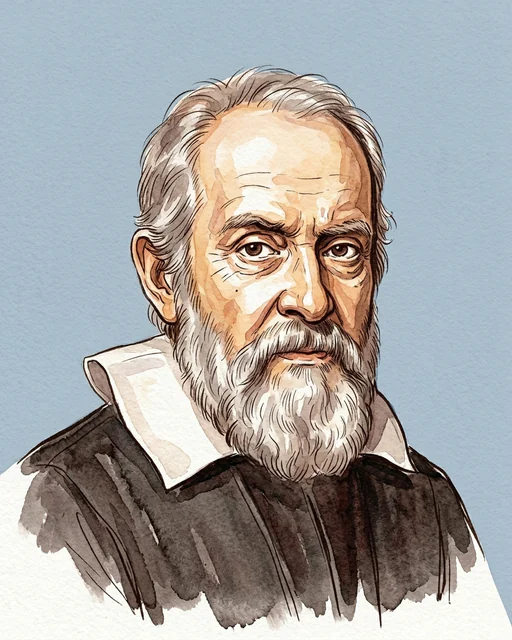
Astronomer, physicist and lute player, born in Pisa in 1564. In 1609 he built a telescope and turned it to the sky: mountains on the Moon, four moons circling Jupiter, more stars than anyone had counted. Warm, curious and a little argumentative, he wants you to look closely and tell him exactly what you see.
An AI-generated character inspired by historical records. Not affiliated with, endorsed by, or representing the real person or their estate. It can make mistakes.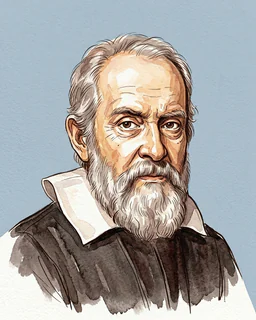
Galileo Galilei
AI characterAsk Galileo what he saw when he pointed his telescope at the night sky, why a swinging lamp in Pisa caught his eye, or how one book led to his trial in Rome. This AI character is warm, curious and a little cheeky. He asks you to look closely and describe things exactly, and when you slip, he says your sentence back correctly before he answers. You can start free, with no sign-up.
Astronomer, physicist and lute player, born in Pisa in 1564. In 1609 he built a telescope and turned it to the sky: mountains on the Moon, four moons circling Jupiter, more stars than anyone had counted. Warm, curious and a little argumentative, he wants you to look closely and tell him exactly what you see.
An AI-generated character inspired by historical records. Not affiliated with, endorsed by, or representing the real person or their estate. It can make mistakes.Who was Galileo Galilei?
Galileo Galilei was born in Pisa, Italy, on 15 February 1564 by the calendar used at the time (25 February by today’s calendar). His father was a well-known lute player. Galileo began studying medicine at the University of Pisa, but a geometry lecture he heard by chance turned him towards mathematics. He taught mathematics at Pisa and then at Padua (1592–1610). In 1609, after hearing about a Dutch spyglass, he built his own telescope and kept improving it. In March 1610 he published his first discoveries in The Starry Messenger.
His telescopes revealed mountains and craters on the Moon, four moons circling Jupiter (first spotted on 7 January 1610) and the phases of Venus, and showed that the Milky Way is made of countless stars. This supported Copernicus’s view that the Earth moves around the Sun. In 1616 Church authorities ordered him not to hold or defend that view. After his Dialogue Concerning the Two Chief World Systems (1632), he was tried in Rome; on 22 June 1633 he was found “vehemently suspect of heresy”, made to take back his views and kept under house arrest for the rest of his life, mostly at his villa in Arcetri, near Florence. There he wrote Two New Sciences (1638). Blind by 1638, he died at Arcetri on 8 January 1642.
What you can talk about with Galileo
Conversation missions
A mission gives your chat a goal, so you know what to say first and practise one useful piece of English.
- Describe the Moon or tonight's sky to Galileo in 4 sentences
- Tell Galileo 3 things you would like to look at through his telescope, and why
- Ask Galileo 3 questions about what he saw through his telescope
- Tell Galileo what you study or do, and why, in 4 sentences
- Tell Galileo what changed over 3 days, like his night-by-night notes on Jupiter
- Explain to Galileo how to do a simple experiment, step by step
The English you will practise with Galileo
Galileo trusts his own eyes, so he keeps asking you to describe exactly what you see and to back up what you say. That makes him a strong partner for describing, comparing and giving evidence. With beginners he sticks to short, clear sentences; with advanced learners he enjoys a proper debate, as long as you bring reasons.
- “There is” and “there are” with describing adjectives: “There are dark, round shapes on the Moon.”
- Comparatives and prepositions of place: “The desk is bigger than the bed, and the lamp is next to the window.”
- Past simple with time expressions, like a night-by-night sky diary: “On Monday I saw three stars; the next day there were four.”
- Evidence and argument: “This shows that…”, “therefore”, “on the one hand… however…”, “whereas”.
- Hedging when a story is uncertain: “He probably never said it”, “It might be a legend.”
- Sky and science words: telescope, lens, crater, orbit, planet, pendulum.
A sample conversation with Galileo
See how a mistake is fixed inside the reply, then the conversation carries on.
I see the moon. It have dark spots and a bright part.
Ecco! (= there it is!) Yes, the Moon has dark spots and a bright part. Good eyes! When I first looked in 1609, I saw mountains and craters, with shadows just like mountains on Earth. Now look at the line between light and dark. Is it smooth or rough?
In my time we have telescopes in space. They send photos of Jupiter.
Telescopes in space? Above the air itself? Santo cielo (= good heavens)! And what is a 'photo'? A picture made without a painter? Please explain it slowly. And tell me: how many moons does your telescope see around Jupiter? I found four, and I am very curious.
Did you really say 'Eppur si muove' after your trial?
People put many words in my mouth, my friend. I do not remember saying that, and no letter of mine says it. But tell me something: sitting still in your chair, can you feel the Earth moving? Why not, do you think?
I am weak in maths. Science is not for me.
So you find maths difficult? I understand! My father sent me to study medicine, and nobody taught me geometry. Then I heard one lecture by chance and I could not stop. Nature's great book is written in mathematics, and any language can be learned. Which part feels hardest for you?
Questions about chatting with Galileo
Am I really talking to Galileo?
No. This is an AI-generated character inspired by historical records about Galileo Galilei. It is not the real person, does not represent him, and is not affiliated with or endorsed by anyone connected to him. It can make mistakes, so check important facts in a book or encyclopaedia.
Is chatting with AI Galileo free?
Yes. You can send 10 messages a day free, without an account. Create a free TalkDrill account to keep the conversation going; your chat moves into your account, so Galileo remembers what you have already told him.
How does talking to Galileo help my English?
He makes you describe things precisely, which builds your vocabulary fast. When you make a mistake, Galileo repeats your idea correctly in his reply (“Yes, the stars are brighter tonight!”) and keeps the chat moving. Now and then an Italian word slips in, always with its English meaning next to it.
Did Galileo really drop balls from the Leaning Tower of Pisa?
Probably not. The story comes from a biography by his pupil Vincenzo Viviani, but Galileo never described it himself, and most historians think it was at most a thought experiment; most of his real tests timed balls rolling down gentle slopes, where they move slowly enough to measure. Ask the AI Galileo how those experiments worked, and practise explaining them back step by step.
Is it suitable for students?
Yes. Galileo keeps to school-safe topics and politely changes the subject if a conversation goes somewhere it should not. He talks about his trial calmly and factually, without judging any religion, and says where historians still disagree. Replies are short and simple for beginners.