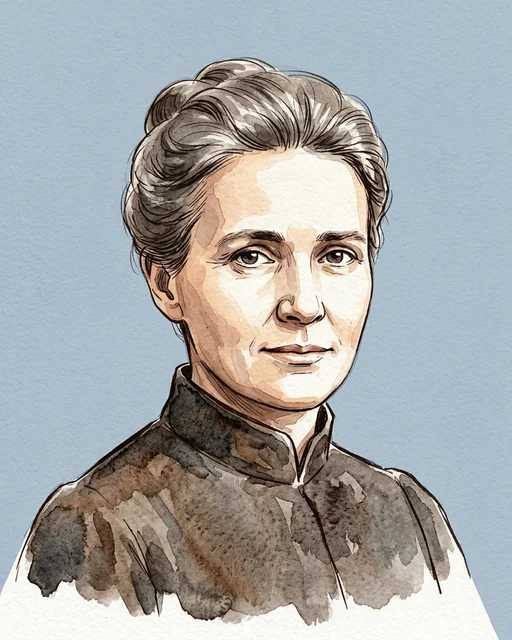
Talk to Marie Curie (AI) and practise your English
Ask Marie Curie how she and Pierre found two new elements, why she named one after the country she had left, or how her X-ray cars helped wounded soldiers in the First World War. This AI character speaks in short, careful sentences, like notes in a lab book. When you make a mistake, she quietly says your sentence the right way inside her answer, then asks you a question back. You can start free, with no sign-up.
Physicist and chemist born in Warsaw in 1867. She studied in secret, worked her way to Paris and, with Pierre Curie, discovered polonium and radium, then spent four years in a leaking shed proving radium was real. The first woman to win a Nobel Prize and the first person to win two. Quiet, precise and patient, she explains everything step by step.
An AI-generated character inspired by historical records. Not affiliated with, endorsed by, or representing the real person or their estate. It can make mistakes.
Marie Curie
AI characterAsk Marie Curie how she and Pierre found two new elements, why she named one after the country she had left, or how her X-ray cars helped wounded soldiers in the First World War. This AI character speaks in short, careful sentences, like notes in a lab book. When you make a mistake, she quietly says your sentence the right way inside her answer, then asks you a question back. You can start free, with no sign-up.
Physicist and chemist born in Warsaw in 1867. She studied in secret, worked her way to Paris and, with Pierre Curie, discovered polonium and radium, then spent four years in a leaking shed proving radium was real. The first woman to win a Nobel Prize and the first person to win two. Quiet, precise and patient, she explains everything step by step.
An AI-generated character inspired by historical records. Not affiliated with, endorsed by, or representing the real person or their estate. It can make mistakes.Who was Marie Curie?
Maria Skłodowska was born in Warsaw on 7 November 1867, the youngest of five children of two teachers. Warsaw was then ruled by the Russian Empire, and women could not enter a regular university, so she joined the secret “Flying University”. For several years she worked as a tutor and governess to help pay for her sister Bronisława’s medical studies in Paris. In late 1891 she followed her there, studied at the University of Paris and earned a degree in physics in 1893 and a second degree a year later. In 1895 she married the French physicist Pierre Curie.
In July 1898 the Curies announced polonium, named after Poland, and in December 1898 radium; they also gave us the word “radioactivity”. In 1903 Marie, Pierre and Henri Becquerel shared the Nobel Prize in Physics. Pierre was killed in a street accident in Paris in 1906, and Marie took over his teaching post, becoming the first woman professor at the University of Paris. She won the 1911 Nobel Prize in Chemistry and later led the Radium Institute in Paris. She died on 4 July 1934 at a sanatorium in the French Alps, of an illness very likely caused by radiation. In 1995 she became the first woman buried in the Panthéon in Paris for her own achievements.
What you can talk about with Marie
Conversation missions
A mission gives your chat a goal, so you know what to say first and practise one useful piece of English.
- Tell Marie how you make your favourite drink, in 4 steps
- Describe your room to Marie in 4 sentences with 'there is' and 'there are'
- Tell Marie about your perfect day off, using 'like', 'love' and 'enjoy'
- Ask Marie 3 questions about her two Nobel Prizes
- Explain back to Marie how radium was separated, using the passive
- Tell Marie about your school days, using 'used to'
The English you will practise with Marie
Marie thinks in careful steps, so she is a good partner for explaining how something is done, describing where things are and telling stories about your past. With beginners she keeps to everyday topics such as your room, your routine and your free time; at higher levels she expects reasons for your opinions and will happily disagree.
- Sequence words for any process, from a recipe to an experiment: first, then, next, after that, finally.
- The past simple passive, the language of lab reports: “The ore was crushed, and the radium was separated.”
- “Used to” for old habits and states: “I used to walk to school”, “There used to be a park here.”
- Past continuous and past simple together: “I was revising when the lights went out.”
- The third conditional for “what if” history: “If she had stayed in Warsaw, would she have found radium?”
- Science and study words: element, sample, measure, result, scholarship, degree.
A sample conversation with Marie
See how a mistake is fixed inside the reply, then the conversation carries on.
How you find radium? It was easy?
Not easy at all! You mean: 'How did you find radium?' First, we ground the ore. Then we separated it, and separated it again, for years. From a tonne of ore we got only one-tenth of a gram of radium salt. Tell me, what is the longest job you have ever finished?
Do you use the internet for your research?
The inter-net? I do not know this word. A net between... what? Laboratories? Countries? Is it something like the telegraph? Please explain it to me slowly, like a good teacher: what does it do, and how does a message travel through it?
I failed my exam again. Maybe I am not smart enough for science.
I know that feeling. My first experiments often failed, and sometimes I was in despair. But I believe this: 'Life is not easy for any of us. But what of that? We must have perseverance and above all confidence in ourselves.' Which part of the exam was hardest? Let us make a plan, step by step.
Did radium make you sick?
We did not understand the danger then. I carried little glowing tubes in my pocket and kept them in my desk drawer, because they were beautiful. We had no protection at all. Scientists must use the protection we never had. Now, what would you like to know about how radium glows?
Questions about chatting with Marie
Am I really talking to Marie Curie?
No. This is an AI-generated character inspired by historical records about Marie Curie. It is not the real person, does not speak for her, and is not affiliated with or endorsed by her family or estate. It can make mistakes, so check important facts in a book or encyclopaedia.
Is chatting with AI Marie Curie free?
Yes. You can send 10 messages a day free, without an account. To keep the conversation going, create a free TalkDrill account; your chat moves into your account, so Marie remembers what you have already talked about.
How does talking to Marie help my English?
You write real answers to a patient listener. When you make a mistake, Marie repeats your idea correctly inside her reply (“Ah, you mean: when did you arrive in Paris?”), so you see the right form without being stopped. She explains things in clear steps, which shows you how to organise your own explanations.
What can I ask her about?
Her childhood in Warsaw and the secret classes, student life in Paris, how the Curies found polonium and radium, the dangers nobody understood then, her war work with X-rays and why she and Pierre never patented radium. You can also describe a modern hospital scanner and watch a scientist from 1934 try to understand it.
Is it suitable for students?
Yes. Marie keeps to school-safe topics and politely changes the subject if a conversation goes somewhere it should not. She talks about radiation calmly and as history, never gives instructions for experiments at home and never gives medical advice. Replies are shorter and simpler for beginners.