
Prayer for School Assembly
With Meaning and Pronunciation
Prayers for school assembly with meanings: Sanskrit shlokas written out and explained, non-religious options, and the anchor's lines that go around the prayer.

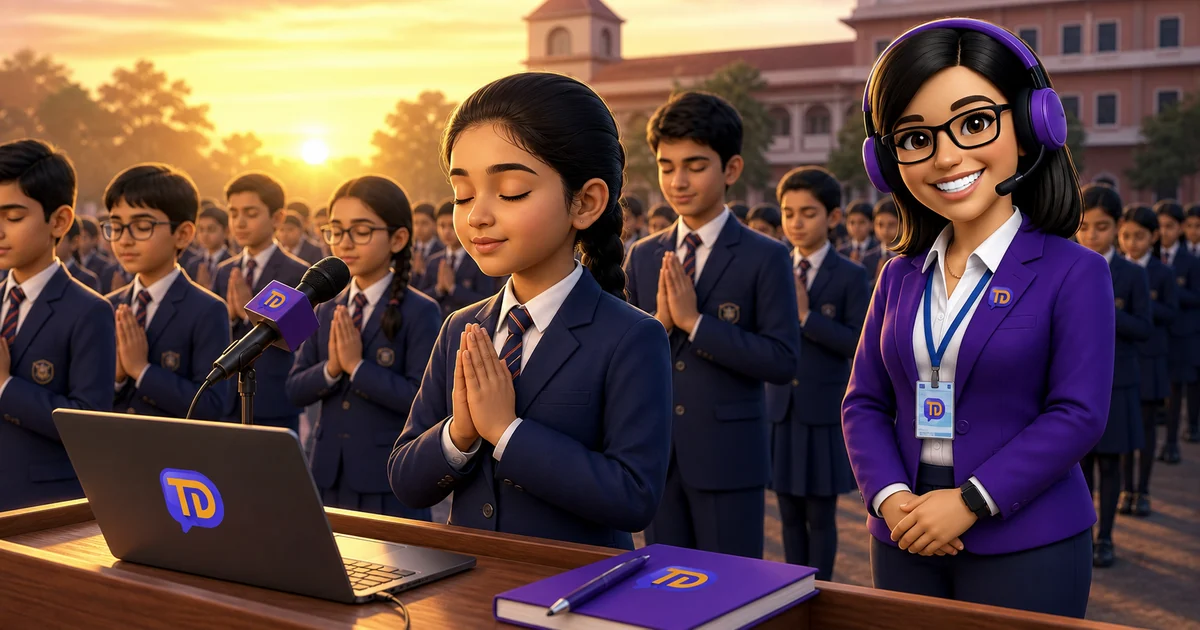
Prayer for School Assembly, With Meaning and Pronunciation
The prayer is the one segment of the assembly that is usually recited from memory and almost never explained. A student can carry a Sanskrit shloka in their head for six years without once being told what it says, which is a strange thing for something recited every morning.
So this page does two jobs. It gives the prayers themselves, written out accurately with their meanings in plain English. And it covers the part nobody prepares for: leading the prayer aloud, which is a different skill from knowing it.
There are Sanskrit shlokas with word-level meanings, non-religious options for schools that need them, a note on the two Hindi prayers most Indian schools actually use, and the anchor's lines that go before and after.
Key Takeaways
- Every Sanskrit prayer below is given with a line-by-line meaning, not just a translation of the whole.
- Pronunciation is marked for the syllables that get flattened — the long vowels and the conjunct consonants.
- Non-religious alternatives are included, written to do the same settling job without invoking anything.
- The two best-known Hindi assembly prayers are film songs under copyright. They are named and credited here, not reproduced.
- Leading a prayer is about pitch and pace, not volume. The notes near the end cover starting on a pitch four hundred people can actually follow.
What Goes Around the Prayer?
The prayer sits after the assembly is called to order and before the news and the thought of the day. The anchor's job is three sentences.
| Beat | हिंदी / Sanskrit cue | English |
|---|---|---|
| Call to order | कृपया सभी सावधान की मुद्रा में खड़े हो जाएँ। | Please stand at attention. |
| Introduce | आइए, दिन का आरंभ प्रार्थना से करें। | Let us begin the day with the prayer. |
| Lead in | __________ की कक्षा ____ प्रार्थना का संचालन करेगी। | Class ____ will lead the prayer. |
| Close | धन्यवाद। कृपया विश्राम की मुद्रा में आ जाएँ। | Thank you. Please stand at ease. |
The full set of linking lines for the rest of the assembly is in our school assembly anchoring script.
Asato Ma Sad Gamaya
From the Brihadaranyaka Upanishad. Probably the most widely used assembly prayer in India that is not a film song, and the shortest to teach.
ॐ असतो मा सद्गमय। तमसो मा ज्योतिर्गमय। मृत्योर्मा अमृतं गमय। ॐ शान्तिः शान्तिः शान्तिः॥
Line by line:
| Sanskrit | Meaning |
|---|---|
| असतो मा सद्गमय | Lead me from the unreal to the real |
| तमसो मा ज्योतिर्गमय | Lead me from darkness to light |
| मृत्योर्मा अमृतं गमय | Lead me from death to immortality |
| ॐ शान्तिः शान्तिः शान्तिः | Om, peace, peace, peace |
Pronunciation: a-sa-to maa sad-ga-ma-ya · ta-ma-so maa jyo-tir-ga-ma-ya · mrit-yor-maa a-mri-tam ga-ma-ya. The one to slow down on is ज्योतिर् — the jyo is a single syllable, not "ji-yo". And the three शान्तिः are said with a pause between each, not run together.
Om Sahana Vavatu
A shanti mantra from the Taittiriya Upanishad. It is a teacher-and-student prayer specifically, which is why it suits a school better than most.
ॐ सह नाववतु। सह नौ भुनक्तु। सह वीर्यं करवावहै। तेजस्विनावधीतमस्तु मा विद्विषावहै। ॐ शान्तिः शान्तिः शान्तिः॥
| Sanskrit | Meaning |
|---|---|
| सह नाववतु | May we both be protected together |
| सह नौ भुनक्तु | May we both be nourished together |
| सह वीर्यं करवावहै | May we work together with energy |
| तेजस्विनावधीतमस्तु | May what we study together be brilliant |
| मा विद्विषावहै | May we never quarrel with each other |
The last line is worth saying the meaning of aloud when you lead it. A prayer whose final request is that teachers and students never quarrel is a more interesting thing to be reciting every morning than the Sanskrit lets on.
Pronunciation: sa-ha naa-va-va-tu · sa-ha nau bhu-nak-tu · sa-ha vee-ryam ka-ra-vaa-va-hai. The fourth line is the long one — break it as te-jas-vi-naav · a-dhee-tam · as-tu and it becomes sayable.
Read this speech aloud before you go on stage
Reading a speech silently is not rehearsing it. Read it aloud in TalkDrill and get scored on pace, pauses and pronunciation — so you know which words you stumble on while there is still time to fix them. Free — after signup.
Saraswati Vandana
The traditional invocation to Saraswati, used at the start of school functions as well as assemblies.
या कुन्देन्दुतुषारहारधवला या शुभ्रवस्त्रावृता। या वीणावरदण्डमण्डितकरा या श्वेतपद्मासना॥ या ब्रह्माच्युतशंकरप्रभृतिभिर्देवैः सदा वन्दिता। सा मां पातु सरस्वती भगवती निःशेषजाड्यापहा॥
Meaning: She who is white as the jasmine, the moon and the dew; who is clothed in white; whose hand is adorned with the veena; who is seated on a white lotus; who is always honoured by Brahma, Vishnu, Shiva and the other gods — may that goddess Saraswati protect me and remove entirely the dullness of my mind.
Pronunciation: this is the hardest one on the page, because the first line is a single compound word four units long. Break it as kun-den-du · tu-shaa-ra-haa-ra · dha-va-laa and it stops being frightening. The final phrase निःशेषजाड्यापहा is nih-she-sha-jaad-yaa-pa-haa — the जाड्य is "dullness", and it is the point of the whole verse.
Gayatri Mantra
From the Rig Veda. Short, and almost universally recognised.
ॐ भूर्भुवः स्वः। तत्सवितुर्वरेण्यं। भर्गो देवस्य धीमहि। धियो यो नः प्रचोदयात्॥
Meaning: We meditate on the glorious light of the divine giver of life, who illuminates the earth, the atmosphere and what lies beyond. May that light awaken our understanding.
The last line, धियो यो नः प्रचोदयात्, is a request for clear thinking — which is a reasonable thing to ask for at ten to eight in the morning.
Two Hindi Assembly Prayers That Are Copyrighted Film Songs
Two Hindi prayers turn up in Indian school assemblies often enough to be mistaken for traditional hymns. Both are film songs, written within living memory and still under copyright, so they are credited here rather than reproduced:
- "Itni Shakti Hamein Dena Data" — from the film Ankush (1986), written by Abhilash, composed by Kuldeep Singh.
- "Hum Ko Man Ki Shakti Dena" — from the film Guddi (1971), written by Gulzar, composed by Vasant Desai.
Both ask for strength of mind rather than for anything material, which is why they carry across a mixed assembly. If your school uses one, get the words from your school's own prayer book or hymn sheet — that is also the version your assembly will actually be singing, which a version off the internet may not be.
Non-Religious Options
For schools that need the settling effect of a prayer without invoking anything. These are written to be read aloud by one voice with the assembly listening, rather than recited in chorus.
Let us stand quietly for a moment.
We are here to learn, and learning asks something of us: attention, patience, and the honesty to say when we have not understood.
Let us be useful to the people beside us today. Let us be fair when it costs us something. And let us leave this ground a little better than we found it.
Let us begin the day.
A shorter one, about twenty seconds:
Let us take a moment before we begin.
For the chance to learn today, and for the people who make it possible — we are grateful.
Let us work honestly, speak kindly, and give our full attention to whatever is in front of us.
Thank you. Good morning, everyone.
And a pledge-style close that works where a spoken prayer is not appropriate:
Today I will listen before I answer. Today I will help someone without being asked. Today I will finish what I begin. Today I will be honest, even when it is easier not to be.
The Lord's Prayer
Used in Christian and convent schools, in the traditional English form.
Our Father, who art in heaven, hallowed be thy name. Thy kingdom come, thy will be done, on earth as it is in heaven. Give us this day our daily bread, and forgive us our trespasses, as we forgive those who trespass against us. And lead us not into temptation, but deliver us from evil. Amen.
Wording varies between denominations and between school hymn books, particularly the ending. Use your school's version.
How Do I Lead the Prayer Aloud?
Leading is a different job from knowing the words, and it is the part nobody rehearses.
Start on a pitch the assembly can follow. People instinctively begin too high when nervous, and four hundred students cannot follow a line pitched at the top of your range. Start lower than feels natural. If the assembly joins in strongly by the second line, your pitch was right.
Set the pace in the first three words, then hold it. A chorus follows whoever started. If you begin quickly you cannot slow down afterwards, because the assembly is already committed. Sanskrit in particular wants a slower pace than Hindi or English — the long vowels need their length or the whole thing turns into a drone.
Breathe at the line breaks, not mid-line. Every prayer above is printed one line per breath. That is not layout; it is where to breathe.
Practise the conjunct consonants, not the whole prayer. The syllables that get flattened are the joined ones: ज्यो in jyotir, ब्रह्मा in the Saraswati Vandana, प्रचोदयात् in the Gayatri. Say those five or six times on their own and the rest carries itself.
Leave a full second of silence at the end before you speak again. Moving straight from the last शान्तिः into "thank you, please stand at ease" undoes the settling the prayer just did.
If you are leading an English prayer, you can paste it into Read Aloud practice (free with a TalkDrill account) and rehearse it out loud, with every word scored. For the general problem of a voice that shakes in front of a crowd, we have written separately about the fear of speaking in front of people.
Common Questions
How long should the assembly prayer be? The Sanskrit shlokas above run twenty to forty seconds recited at a proper pace. The Saraswati Vandana is the longest at around a minute. If your slot is tight, Asato Ma is the shortest complete prayer here.
Does the prayer have to be religious? No, and the non-religious section above is written for exactly that. What the prayer segment actually does in an assembly is settle four hundred people and mark the start of the day, and a reflection or a pledge does that job.
Do I need to explain the meaning? Not as part of the recitation. But if you are leading it, know the meaning anyway — a prayer led by someone who understands it sounds different from one led by someone reciting syllables, and teachers do ask.
Can the prayer be in Hindi and the rest of the assembly in English? Yes, and that is a common arrangement. Keep whichever pattern your school uses consistent through the week rather than switching day to day.
What comes after the prayer? Usually the news headlines and the thought of the day. We have both written out: news reading for school assembly and thought of the day with meanings.
Say It Aloud Before Tomorrow
Reciting silently and leading four hundred people are not the same skill, and only one of them happens at ten to eight in the morning. Pick your prayer, read the meaning once so you know what you are saying, and read it aloud standing up three times — starting lower than feels natural.
If you are conducting the whole assembly rather than only the prayer, our guide to how to conduct a school morning assembly covers the commands, the sequence and the timing from the first call to dispersal.
Meghanand Kumar
Strategic Advisor
Strategy and AI/hardware advisor. MS, Université Paris-Saclay.
Turn anything you read into speaking practice
Install the free TalkDrill Chrome extension: highlight any sentence on any website or YouTube video, say it aloud, and get an instant pronunciation score with word-by-word feedback.
Related Articles
Continue reading more from TalkDrill Blog
Stay Updated with TalkDrill
Get the latest English learning tips and AI insights delivered to your inbox.