
The campus placement panel: three interviewers, one chair
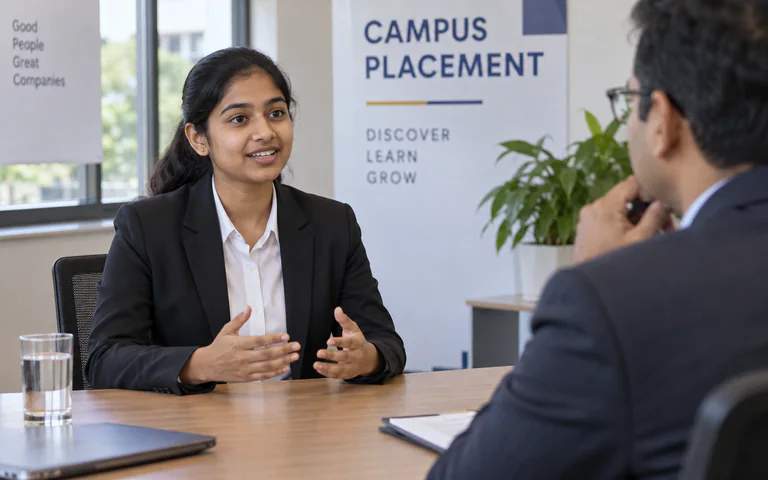
The final round of a core-sector drive at Anand Motors. Three people across the table: a plant manager who chairs, an HR manager, and a quiet senior engineer who has said nothing for six minutes and will ask the hardest question. The panel is the format most students have never practised, and it is the one where eye contact and turn-taking decide as much as the answers.
An advanced-level session of about 12 minutes. 7 questions, each answered out loud.
Three people at a table are not one interviewer multiplied by three. The chair is running the clock and deciding whether the round ends early. The HR manager is listening for whether you will accept the posting and stay in it. The engineer who has not spoken is reading your resume line by line and will pick the one claim you cannot defend. An answer that satisfies all three at once is rare, so let them stay separate: answer the question that was asked, to the person who asked it, and let the others take their own turn rather than trying to cover everybody in one paragraph. The hardest moment comes when two of them push from opposite sides. This is an advanced round, and what is under test is not knowledge but whether you stay coherent while being pulled.
Angles worth taking
- Answer to whoever asked, then take in the other two as you close — that is what turn-taking looks like here.
- When the chair hands the questioning to a colleague, stop and reset rather than running your previous answer on into the new question.
- If two panellists want opposite things, name the trade-off out loud instead of quietly picking one and hoping the other missed it.
- Give the silent engineer a direct, concrete answer when they finally speak; hedging there undoes an hour of good HR answers.
- Use 'I do not know — here is how I would find out' once if needed; three people spot a bluff fast.
- Keep answers shorter than you would one-on-one: a panel has three sets of follow-ups to fit into the same slot.
Who is in the room
You play
A final-year engineering student in a final panel round
You speak with
The plant manager chairing a three-person panel, who hands questions to an HR colleague and to a silent senior engineer, and returns to them by name
Phrases to reach for
These are shown to you before the session starts. They are what you are asked to use, not a list the scorer is checking off.
Ready to speak?
Free to start. You need a TalkDrill account to speak — reading this page does not.
Browse all mock interview roundsThe format
Questions in this round
7
Modes
Learn (guided) · Mock (exam-real)
How a mock interview session works
Pick a round
HR, behavioural, or a role-specific set. Each one tells you how many questions it runs and roughly how long it takes.
Answer out loud
Questions come one at a time and you speak the answer. There is a clock, because a two-minute answer and a five-minute answer are different answers.
Take the follow-ups
Answers get followed up. A vague claim gets pressed on, which is what separates a rehearsed answer from a true one.
Read the report
Structure, evidence, filler and pace per answer, plus the one answer worth recording again before the real thing.
What you're scored on
Every round is assessed the same way, because interviewers are broadly consistent about what a good spoken answer contains.
Answer the chair while acknowledging the whole panel, hold your position when two of them push from different directions, and give the quiet one a straight answer when they finally speak.
Structure
Whether the answer has a shape — situation, action, result — or arrives somewhere by accident after ninety seconds.
Evidence
Specifics over adjectives. "We cut it from six days to two" against "we improved the process significantly".
Relevance
Whether you answered the question asked, including the follow-up, rather than the question you prepared for.
Delivery
Pace, filler words, and whether the last third of the answer is as clear as the first.
More mock interview rounds

All mock interview rounds · Placement rounds · All speaking practice