
"Tell me about yourself" — the ninety seconds that set the round
The first question of almost every campus interview, and the one most students waste by reciting their resume from the top. You get roughly ninety seconds. What you choose to put in them decides what the interviewer asks next — which means this answer is the only part of the round you fully control.
A beginner-level session of about 7 minutes. 6 questions, each answered out loud.
Treat the answer as bait. Every noun you put in it is something the interviewer can pick up, and most of the round will be spent on whatever you mentioned — so name the things you want to be asked about and leave out the ones you do not. Four items fit comfortably in ninety seconds: what you are studying and where, one thing you built or ran, one strength with a half-line of proof, and why you are in this chair. School marks, family background and a list of hobbies are the parts most often included and least often followed up. This is a beginner-level round in the sense that nothing in it is hard to answer; the difficulty is finishing cleanly. An answer that trails off into a shrug has given away the one part of the round you fully controlled.
Angles worth taking
- Plant one hook you want the next question to land on — a project, a contest, a part-time job.
- Open in the present: what you are doing now, then a single line on how you got here.
- Attach evidence to the strength in the same breath, or it reads as a phrase you liked the sound of.
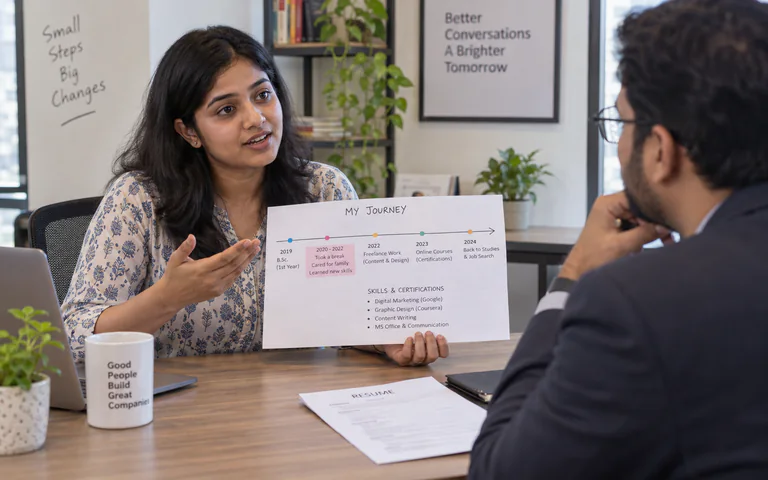
- Skip the chronological march through every year of the degree; take the two years that matter to this role and leave the rest.
- Close on a sentence that points forward — why this role, why now — so the interviewer knows the answer has ended.
Who is in the room
You play
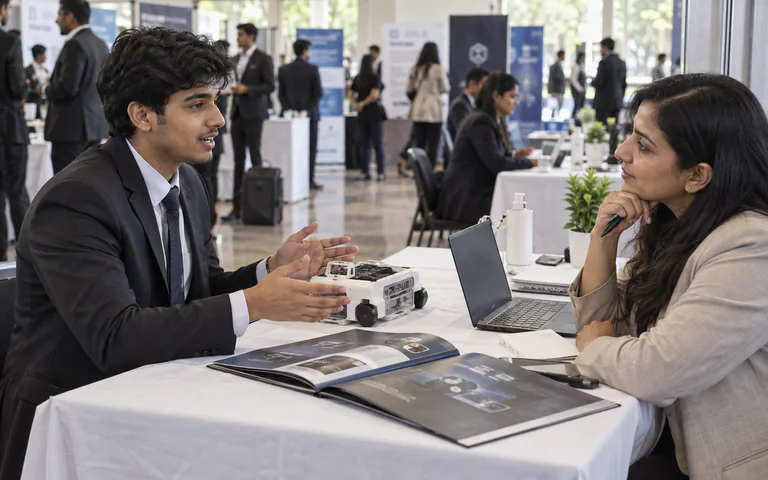
A final-year student at the start of a placement interview
You speak with
An interviewer who opens with this question, listens without interrupting, and then asks follow-ups drawn ONLY from what the candidate chose to mention
Phrases to reach for
These are shown to you before the session starts. They are what you are asked to use, not a list the scorer is checking off.
Ready to speak?
Free to start. You need a TalkDrill account to speak — reading this page does not.
Browse all mock interview roundsThe format
Questions in this round
6
Modes
Learn (guided) · Mock (exam-real)
How a mock interview session works
Pick a round
HR, behavioural, or a role-specific set. Each one tells you how many questions it runs and roughly how long it takes.
Answer out loud
Questions come one at a time and you speak the answer. There is a clock, because a two-minute answer and a five-minute answer are different answers.
Take the follow-ups
Answers get followed up. A vague claim gets pressed on, which is what separates a rehearsed answer from a true one.
Read the report
Structure, evidence, filler and pace per answer, plus the one answer worth recording again before the real thing.
What you're scored on
Every round is assessed the same way, because interviewers are broadly consistent about what a good spoken answer contains.
Deliver a ninety-second introduction that names your stream, one thing you built, one thing you are good at with evidence, and why you are sitting in this chair — then let it lead the interviewer where you want to go.
Structure
Whether the answer has a shape — situation, action, result — or arrives somewhere by accident after ninety seconds.
Evidence
Specifics over adjectives. "We cut it from six days to two" against "we improved the process significantly".
Relevance
Whether you answered the question asked, including the follow-up, rather than the question you prepared for.
Delivery
Pace, filler words, and whether the last third of the answer is as clear as the first.
More mock interview rounds




All mock interview rounds · Placement rounds · All speaking practice