
HR round: mass-recruiting IT services company
You cleared the aptitude cut-off and the L1 technical round at Sundar Systems on your campus drive. This is the HR round: fifteen minutes, one interviewer, and it decides the offer. They are not testing your code here — they are testing whether you will join, stay through the service agreement, and be someone a client can be put in front of.
An intermediate-level session of about 10 minutes. 8 questions, each answered out loud.
This round is administrative in a way candidates consistently underestimate. The person opposite is not deciding whether you are good at the job — a previous round settled that — but whether you will accept, whether you will stay the term, and whether you can be put in front of a client without supervision. Every question maps to a line on a form, so the round moves fast and an answer that runs past a minute pushes the rest of it into a hurry. Two items usually decide the outcome. Relocation wants a straight yes with its condition attached, or a straight no; 'I am flexible with anything' followed by a pause reads as neither. The service agreement wants you to say you have read it and know the term. And a weak semester wants an honest number with its cause in one clause, because an excuse invites the follow-up an explanation closes.
Angles worth taking
- Answer the form question first and add the colour after; this interviewer is filling a field and needs the value before the reasoning.
- Answer the relocation question with a place and a month, not with willingness in the abstract.
- If your CGPA dips somewhere, give the semester, the reason in one clause, and the recovery — then stop.
- Tie 'where do you see yourself in three years' to a role inside this company; a plan that ends elsewhere answers their real worry badly.
- Do not claim this is the only company you applied to; on a campus drive everybody applies to everything.
- Have one question ready about the training period or the first project. No questions at the end reads as no intent to join.
Who is in the room
You play
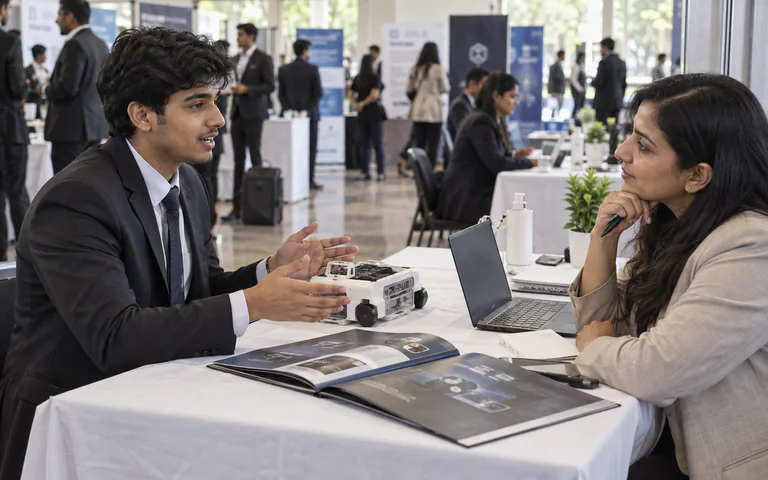
A final-year engineering student in the HR round of an on-campus drive
You speak with
An HR executive at Sundar Systems running the final round of a campus drive, working through a checklist and taking notes
Phrases to reach for
These are shown to you before the session starts. They are what you are asked to use, not a list the scorer is checking off.
Ready to speak?
Free to start. You need a TalkDrill account to speak — reading this page does not.
Browse all mock interview roundsThe format
Questions in this round
8
Modes
Learn (guided) · Mock (exam-real)
How a mock interview session works
Pick a round
HR, behavioural, or a role-specific set. Each one tells you how many questions it runs and roughly how long it takes.
Answer out loud
Questions come one at a time and you speak the answer. There is a clock, because a two-minute answer and a five-minute answer are different answers.
Take the follow-ups
Answers get followed up. A vague claim gets pressed on, which is what separates a rehearsed answer from a true one.
Read the report
Structure, evidence, filler and pace per answer, plus the one answer worth recording again before the real thing.
What you're scored on
Every round is assessed the same way, because interviewers are broadly consistent about what a good spoken answer contains.
Come across as someone who will actually join and stay: be specific about why this company, be honest about your academics, and answer the relocation and service-agreement questions without hedging.
Structure
Whether the answer has a shape — situation, action, result — or arrives somewhere by accident after ninety seconds.
Evidence
Specifics over adjectives. "We cut it from six days to two" against "we improved the process significantly".
Relevance
Whether you answered the question asked, including the follow-up, rather than the question you prepared for.
Delivery
Pace, filler words, and whether the last third of the answer is as clear as the first.
More mock interview rounds





All mock interview rounds · Placement rounds · All speaking practice