
Mock Interview Practice with AI — Free Practice Scenarios
Skip to main content
Popular:
IELTS Speaking
Interview Tips
Pronunciation
Daily Practice
Workplace English
Vocabulary

Interview Scenarios

Free mock interview practice with AI: realistic scenarios for HR, behavioral and technical rounds, with full scripts and spoken practice rounds that end with a report.

Job interviews are one of the highest-pressure English speaking situations you will ever face. The stakes are real, the time is limited, and every word you say is being evaluated. For non-native speakers, the challenge doubles because you are simultaneously thinking about your answers and worrying about your language. The result is often hesitation, filler words, and answers that sound weaker than they actually are.

The most effective way to overcome interview anxiety is through repeated practice with realistic scenarios. When you have already answered "Tell me about yourself" or "Why should we hire you?" dozens of times, the real interview feels like familiar territory rather than an ambush. Your responses become sharper, your delivery becomes smoother, and your confidence becomes visible to the interviewer.

This section covers complete mock interview scripts for HR rounds, behavioral questions using the STAR method, technical introductions, salary negotiations, and common tricky questions that catch candidates off guard. Each scenario includes full dialogues, model answers, and professional phrases that you can adapt to your own experience. Whether you are a fresher preparing for your first interview or an experienced professional targeting a senior role, practicing these conversations will help you walk into any interview room with genuine confidence and clarity.
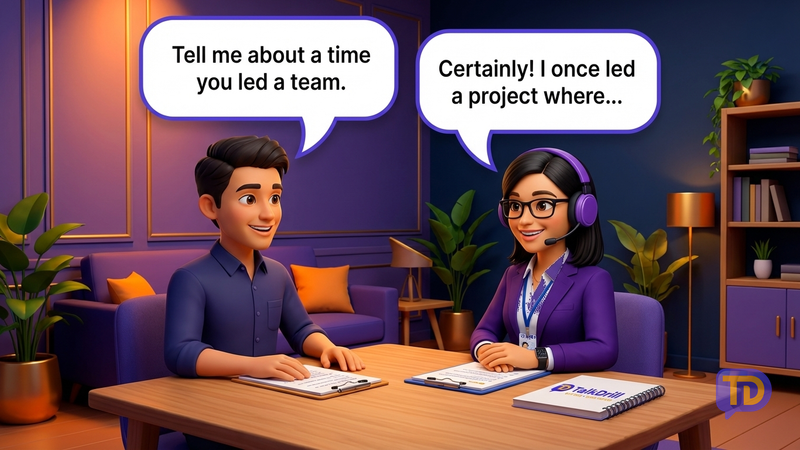
How can I practice a mock interview by myself?

Pick 8-10 common questions (tell me about yourself, why should we hire you, your strengths and weaknesses), write short bullet answers, then answer them aloud while recording yourself. Review each recording for filler words, pace, and clarity, and repeat the weak answers. A spoken mock interview round on TalkDrill makes this loop faster because the AI interviewer asks follow-up questions and the report afterwards flags structure, filler words and pace.

Are AI mock interviews good practice for real interviews?

Yes - AI mock interviews remove the two biggest barriers to practice: scheduling and embarrassment. You can rehearse the same answer ten times, get instant feedback on fluency, vocabulary, and filler words, and practice at midnight before the interview. Use AI for repetition and fluency, then do one or two human mock rounds for body language if possible.

What questions are asked in a mock interview?

A realistic mock interview covers four groups: self-introduction (tell me about yourself), motivation (why this company, why should we hire you), behavioral questions using the STAR method (tell me about a time you handled conflict), and role or salary questions (what are your salary expectations). The scripts in this section include model answers for each group.

How many mock interviews should I do before the real one?

Three to five full mock rounds is the practical sweet spot. The first run exposes weak answers, the second and third make your stories smooth without sounding memorized, and the last ones build calm under time pressure. Doing one round daily in the week before your interview works better than a single long marathon session.

What is the STAR method in interviews?

STAR stands for Situation, Task, Action, Result - a four-part structure for answering behavioral questions. Briefly set the scene (Situation), state what you were responsible for (Task), explain what you actually did (Action), and finish with the measurable outcome (Result). It keeps answers concrete and around 60-90 seconds long.

How do I stop being nervous in English interviews?

Nervousness drops with familiarity, not willpower. Rehearse your self-introduction until you can deliver it without thinking, practice answering unexpected questions aloud daily, and slow your speaking pace deliberately - slower answers sound more confident and give you time to think. Most candidates feel noticeably calmer after a week of daily spoken practice.