
Quick Overview: TalkDrill vs Lingoda
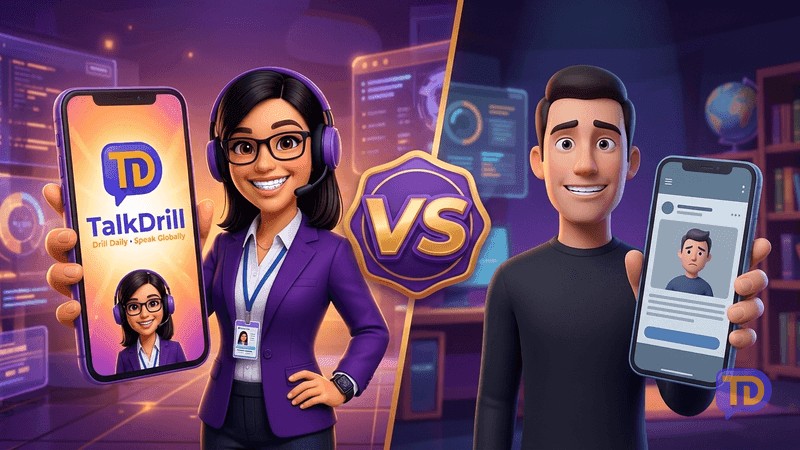
This comparison pits two genuinely different models against each other: TalkDrill — always-on AI conversation practice at a fraction of classroom cost — versus Lingoda — live online group classes taught by qualified teachers with structured curriculum and certificates.
Both apps help you improve English speaking. The question is whether you need a teacher-led classroom experience — or whether AI-powered conversation practice delivers the outcomes you need at a price that makes daily practice sustainable.
What is TalkDrill?
TalkDrill is an English speaking practice platform on the web and Android, used by 30,000+ learners, many of them Indian students and professionals preparing for interviews and workplace English. Most of the practice is with AI tutors by voice, video or chat, any time of day, and every AI session ends with a scored report on grammar, vocabulary, fluency and pronunciation.
It covers casual conversation, role-plays, job interviews (including one built from a job description you paste), IELTS Speaking, read-aloud passages and daily situations. Learn adds two short courses, English Grammar Basics and Everyday Spoken English. For human contact, you can call other learners, join live group voice Rooms, or book one-to-one sessions with verified tutors. With a small free plan and about 30 minutes a day on Pro at $4.99/month, it makes frequent practice accessible to everyone.
What is Lingoda?
Lingoda is a Berlin-based online language school founded in 2013 that offers live group classes with qualified teachers via video conferencing. Classes typically have 3-5 students (sometimes fewer), follow a structured CEFR-aligned curriculum, and run 60 minutes each.
Lingoda's teachers are certified language instructors, not just native speakers. The curriculum is professionally designed with structured materials, homework, and assessments. Students who complete courses receive verifiable certificates. Lingoda now also markets AI-powered self-study materials for practice between classes, so it is no longer a teachers-only service.
Feature-by-Feature Comparison
Practice Availability
Winner: TalkDrill
TalkDrill is available 24/7. You open the app and start speaking. No booking, no scheduling, no waiting for a class slot. Lingoda requires advance booking and operates within scheduled time slots. If your schedule changes or you want to practice at midnight, TalkDrill is there. Lingoda is not.
Teacher Quality
Winner: Lingoda
Lingoda's teachers are certified professionals who can explain nuanced grammar, give contextual feedback, and adapt to your specific needs. AI feedback from TalkDrill is excellent for grammar and fluency patterns, but cannot match a human teacher for nuanced linguistic insight. TalkDrill does let you book one-to-one sessions with verified human tutors (Pro+ includes 4 a month), but it has no teacher-led class programme like Lingoda's.
Cost per Practice Hour
Winner: TalkDrill by a large margin
Lingoda charges per class, and even its smallest bundle of 4 one-hour group classes costs more than a year of TalkDrill Pro. TalkDrill Pro at $4.99/month allows up to about 2 hours of AI practice a week (about 8 hours a month), well under $1 per hour. The math overwhelmingly favors TalkDrill for volume practice.
Certification
Winner: Lingoda
Lingoda provides CEFR-aligned completion certificates. This matters if you want to demonstrate your English level to employers or universities. TalkDrill does not currently offer formal certification.
Interview Preparation
Winner: TalkDrill
TalkDrill's mock interviews are built for job interview scenarios: HR, behavioural and technical rounds, an interview generated from a job description you paste, and a Story Bank for your own STAR answers. Lingoda offers general English conversation skills but no interview-specific coaching.
Pricing Comparison
TalkDrill Pricing
- Free: about 2 minutes of AI voice a day, with no end date, plus free games, e-books and one peer call a week
- Pro Monthly: $4.99/month (₹299 in India), about 30 minutes a day (around 2 hours a week)
- Pro Annual: $47.88/year (₹2,868 in India)
- Pro+: $9.99/month (₹799 in India), about 60 minutes a day plus 4 one-to-one human tutor sessions a month
Lingoda Pricing
- Trial: 7-day trial with 3 group classes or 1 private class
- Flex bundles: 4, 12, 24 or 48 group classes; the price per class falls as the bundle grows
- Sprint and Marathon: intensive programmes that give part of the fee back for near-full attendance
Pros and Cons
TalkDrill Pros
- Available 24/7 with instant access — no scheduling
- Up to 30 minutes of conversation a day for $4.99/month
- Dedicated interview preparation AI coaching
- Immediate feedback on grammar, vocabulary, fluency, pronunciation
- Free plan to try it, no card needed
- Far cheaper than Lingoda per hour of speaking practice
TalkDrill Cons
- No teacher-led classes; human tutors are 1:1 bookings (4 a month on Pro+)
- No CEFR certificate or formal credential
- Peer practice is voice calls and Rooms with other learners, not a class run by a teacher
- Requires internet connection
Lingoda Pros
- Certified professional teachers in every class
- CEFR-aligned curriculum with clear progression
- Verifiable completion certificate
- Small group interaction (typically 3-5 students)
- Structured homework and assessments
- Sprint Marathon program with refund incentive
Lingoda Cons
- Expensive: the smallest class bundle costs more than a year of TalkDrill Pro
- Requires advance scheduling
- Limited practice hours per month at standard pricing
- Not suitable for daily high-volume practice
- Group format limits individual speaking time per session
Who Should Use Each App?
Choose TalkDrill If You:
- Want to practice English every single day without paying per class
- Are preparing for job interviews and need realistic scenario practice
- Have a busy or unpredictable schedule that makes booking classes difficult
- Already have basic English and need to convert knowledge into fluent speech
- Want immediate feedback without waiting for class times
Choose Lingoda If You:
- Need a CEFR certificate for employment or academic applications
- Learn better in a structured classroom with teacher accountability
- Are an advanced learner who benefits from nuanced teacher feedback
- Have the budget for class bundles and want a premium classroom experience
- Want the social motivation of learning with classmates
Scheduling vs Always-On Practice
One of the most practical differences between TalkDrill and Lingoda is how you access practice time. This matters more than most learners initially realize.
Language acquisition research consistently shows that frequency of practice matters more than session length. A 15-minute daily practice session produces better results than a 2-hour weekly class. This gives TalkDrill a structural advantage — its always-on availability makes daily practice frictionless.
With Lingoda, you must book classes in advance, clear your schedule, join at the right time, and often wait for a slot you want. If you miss a class, you lose that session. This scheduling friction reduces practice frequency for many learners, especially those with demanding work or family schedules.
TalkDrill removes all this friction. Open the app, start a conversation, practice for 10-20 minutes, done. This ease of access is why many learners who try Lingoda and find the scheduling burdensome end up switching to AI-based alternatives.
Indian Learner Perspective
For Indian professionals and students, the Lingoda vs TalkDrill decision often comes down to budget and schedule flexibility. Lingoda's class bundles are a significant investment for most Indian learners, priced well above a year of TalkDrill Pro. At that price point, the commitment can feel like pressure rather than motivation.
TalkDrill Pro at ₹299/month in India ($4.99 elsewhere) is affordable for most working professionals and students. The free plan (about 2 minutes of AI voice a day) lets you try it first.
For interview preparation specifically — a priority for many Indian learners targeting IT companies, MNCs, or international roles — TalkDrill's dedicated interview AI coaches are directly relevant. Lingoda's general English curriculum, while excellent, does not offer the targeted interview scenario practice that TalkDrill provides.
For learners who also want to complement speaking practice with writing skills, PenLeap offers AI-powered writing feedback with rubric-based analysis — a useful complement for comprehensive English communication development.
Our Verdict
For structured curriculum, teacher quality, and certification: Lingoda wins.
The cost difference is decisive for most learners. TalkDrill provides daily AI conversation practice, dedicated interview preparation, and immediate feedback, at $4.99/month. Lingoda provides certified teacher instruction, structured curriculum, and verifiable credentials — at class-bundle prices that start above a year of TalkDrill Pro.
Our recommendation: Start with TalkDrill for daily practice and interview preparation. If you want some human feedback without a class timetable, Pro+ ($9.99/month) adds 4 one-to-one tutor sessions a month. If you later need a CEFR certificate or want structured classroom interaction, add Lingoda as an intensive. You'll have better conversations in Lingoda classes after consistent TalkDrill practice anyway.