
ELSA Speak vs Bold Voice: Two Approaches to Sounding Better in English
ELSA Speak and Bold Voice are both AI-powered tools that promise to improve how you sound in English — but they target completely different problems. ELSA Speak fixes the sounds you produce (phonemes, accent, pronunciation accuracy). Bold Voice improves how you use your voice — pace, confidence, authority, and presence.
Understanding this distinction is essential. Many learners think they have a pronunciation problem when they actually have a confidence or delivery problem — and vice versa. This comparison will help you identify which dimension is your real bottleneck.
What is ELSA Speak?
ELSA (English Language Speech Assistant) was founded in 2015 with a focus on pronunciation accuracy. Its AI engine analyzes your speech at the phoneme level — the individual sounds that make up words — and provides color-coded feedback on exactly which sounds are correct, close, or wrong.
The Science Behind ELSA
ELSA's technology has been trained on voice data from speakers with 200+ native language backgrounds. Its phoneme analysis has been validated in research at Stanford and Oxford. When ELSA tells you that your "th" sound is incorrect, it is making a scientifically grounded judgment about the acoustic properties of your speech compared to a native English reference.
What ELSA Targets
ELSA specifically addresses the sounds that differ between your native language and English:
- The "th" sound (dental fricative) — absent in most Indian languages
- The "v/w" distinction — confused by many Hindi speakers
- Vowel sounds — Indian English vowels differ from RP and American English patterns
- Specific consonant clusters and endings that Indian English often simplifies
ELSA builds a personalized learning path around your weakest sounds, giving you targeted drills until your accuracy score improves.
What is Bold Voice?
Bold Voice launched in 2019 with a different premise: pronunciation accuracy is not the only thing that makes someone sound compelling. How you pace your speech, how much authority your voice projects, and how confidently you deliver your words matter as much as individual sound accuracy.
The Celebrity Coaching Angle
Bold Voice's marketing differentiator is celebrity voice coaching — the app teaches techniques used by famous communicators like Oprah Winfrey, Barack Obama, and Morgan Freeman. The idea is that studying world-class communicators provides aspirational models beyond just "correct" pronunciation.
What Bold Voice Targets
Bold Voice focuses on dimensions of speaking that most pronunciation apps ignore:
- Pace and rhythm: Speaking too fast (common under anxiety) or too slow
- Voice authority: Projecting confidence through vocal tone and delivery
- Clarity and articulation: Crisp, clear pronunciation without phoneme-level analysis
- Presentation skills: Public speaking, executive communication, and professional presence
- American English delivery patterns: The cadence and style of natural American speech
Feature Comparison: Where Each App Wins
Pronunciation Accuracy
Winner: ELSA Speak — significantly
For fixing specific mispronounced sounds, ELSA's phoneme-level analysis is in a different category. Bold Voice provides voice analysis and general pronunciation coaching but does not break down individual phonemes. If you mispronounce "th" as "t" or confuse "v" and "w," ELSA will identify this precisely; Bold Voice will not.
Delivery and Presence
Winner: Bold Voice — exclusively
ELSA says nothing about pace, authority, or confidence. It purely analyzes sound accuracy. Bold Voice addresses the psychological and stylistic dimensions of speaking — features that no pronunciation app including ELSA touches. For learners who already speak clearly but want to speak more powerfully, Bold Voice fills the gap.
Systematic Learning
Winner: ELSA
ELSA's personalized learning path, daily goals, streaks, and progress tracking create a structured improvement system. Bold Voice's content is more module-based and less systematically personalized to your specific weaknesses.
Value for Money
Winner: ELSA
ELSA's yearly plans ($89.99 for Pro, $99.99 for Premium on elsaspeak.com) are significantly more affordable than Bold Voice at about $149.99/year. Given ELSA's more systematic approach and larger user validation, it provides more value per dollar for most learners.
Pricing Comparison
| Plan | ELSA Speak | Bold Voice |
|---|---|---|
| Free | Limited daily exercises; 7-day trial of the full app | 7-day free trial |
| Monthly | Varies by region (check the app) | About $24.99/mo |
| Annual | $89.99/yr (Pro), $99.99/yr (Premium) | About $149.99/yr (~$12.50/mo) |
ELSA prices from elsaspeak.com and Bold Voice prices from boldvoice.com, checked October 2026. Both apps run frequent promotions.
On annual plans, Bold Voice costs about 50% to 67% more than ELSA. Whether this premium is justified depends entirely on whether Bold Voice's delivery and confidence coaching addresses your specific challenge — if it does, the higher cost may be warranted.
Our Verdict
For professionals and advanced speakers: Bold Voice fills a gap that ELSA cannot — if you already pronounce words correctly but want to speak with more authority, clarity, and confidence in American English contexts.
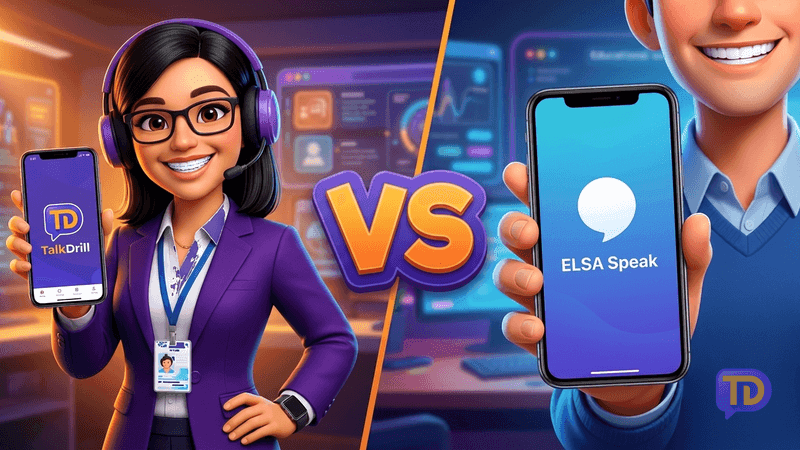
The ideal combination for a serious English learner: ELSA for 10 minutes (fix your sounds) + TalkDrill for 15 minutes (practice those sounds in real conversation) + Bold Voice occasionally (develop executive presence for high-stakes situations). This three-layer approach addresses accuracy, fluency, and confidence together.
Looking for Something Different?
Both ELSA and Bold Voice focus mostly on pronunciation and delivery in scripted contexts — exercises where you read predetermined content (ELSA's AI role-plays are the exception). The missing dimension is practicing clear pronunciation and confident delivery during actual conversations, where you must simultaneously think, formulate, and deliver.
This is the gap that TalkDrill fills. Used by 30,000+ learners, TalkDrill creates real-time AI conversations where you must think and respond spontaneously — and provides feedback on pronunciation, grammar, vocabulary, and fluency together. The challenge of maintaining clear pronunciation while actually communicating is different from pronunciation drills, and TalkDrill specifically trains this real-world skill. For sound-level checks, its Read Aloud practice scores a passage word by word and highlights misread words with their phonemes; ELSA's drills still go deeper.
Use ELSA or Bold Voice for targeted pronunciation and delivery work, then use TalkDrill to apply those improvements in actual conversation practice. This combination produces faster, more durable results than any single tool alone. The technology powering these modern English learning tools reflects the broader trend in AI-driven education that companies like Softechinfra are helping to build and scale.