
Quick Overview: Duolingo vs ELSA Speak
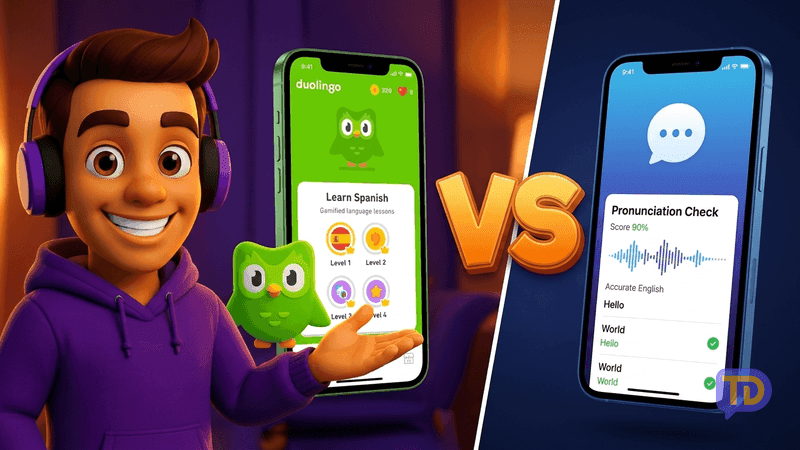
Duolingo and ELSA Speak are two of the most popular English learning apps in the world, but they approach language learning from completely different angles. Duolingo is a full-featured language learning platform with gamified lessons covering reading, writing, listening, and speaking. ELSA Speak is a specialized pronunciation coach that uses AI to perfect your accent at the phoneme level.
This comparison will help you decide which app matches your current English level and learning goals. Spoiler: many learners end up using both, and we'll explain exactly how.
What is Duolingo?
Duolingo is the world's most downloaded language learning app, with more than 140 million monthly active users (Duolingo shareholder letter, Q2 2026). Founded in 2011 by Luis von Ahn and Severin Hacker, it offers courses in 40+ languages. For English learners, Duolingo provides a structured curriculum from beginner (A1) to upper-intermediate (B2) levels.
How Duolingo Works
Duolingo breaks language learning into short, bite-sized lessons (5-15 minutes) organized into skill trees. Each lesson uses a mix of:
- Translation exercises — translate sentences between your native language and English
- Listening exercises — hear English audio and type or select what you heard
- Speaking exercises — read sentences aloud for basic pronunciation checks
- Matching and fill-in-the-blank — reinforce vocabulary and grammar patterns
The app is famously addictive thanks to its gamification system: daily streaks, XP points, achievement badges, leaderboards, and leagues. The green owl mascot ("Duo") sends persistent notifications reminding you to practice — a feature that has become a viral meme but genuinely keeps millions of users consistent.
Duolingo's English Course Strengths
Duolingo's English course is one of its most developed offerings. It covers:
- Essential vocabulary organized by real-life topics (food, travel, work, family)
- Grammar concepts introduced progressively with tips and explanations
- Stories feature with interactive reading comprehension
- Duolingo Podcast for advanced listening practice
- Duolingo English Test (DET) — an accepted alternative to IELTS/TOEFL at many universities
Duolingo's top paid tier, Duolingo Max, adds Video Call with Lily, an AI conversation partner. Duolingo's help centre (checked October 2026) lists Video Call for Max subscribers learning English on iOS and Android; Max is bought inside the mobile app and the price is shown there.
What is ELSA Speak?
ELSA (English Language Speech Assistant) is a pronunciation-focused English learning app with 90 million+ users (elsaspeak.com, checked October 2026). Founded in 2015 by Vu Van, a Vietnamese entrepreneur who experienced pronunciation challenges firsthand, ELSA uses proprietary AI trained on speech data from speakers with diverse accents.
How ELSA Speak Works
ELSA presents words, phrases, sentences, or short dialogues for you to read aloud. Its AI engine then:
- Analyzes each phoneme (individual speech sound) in your recording
- Color-codes your performance — green for correct, orange for close, red for incorrect sounds
- Shows mouth diagrams with tongue placement tips for problem sounds
- Tracks improvement over time across different sound categories
ELSA also offers an initial assessment that identifies your weakest sounds and builds a personalized learning path. If you struggle with the "th" sound (common for Hindi, Tamil, and many Asian language speakers), ELSA will prioritize exercises targeting that specific phoneme.
ELSA now also offers ELSA AI, role-play conversations on a scenario you choose, with feedback afterwards (elsaspeak.com, checked October 2026). The drills are still the heart of the app.
ELSA's Key Technology
ELSA claims 97% accuracy in speech recognition, validated by research at Stanford and Oxford. The AI has been trained on over 100 million voice samples from non-native speakers across 200+ nationalities, making it particularly good at understanding and correcting accented English.
Feature-by-Feature Comparison
Here's how Duolingo and ELSA stack up across the features that matter most for English learners:
Learning Approach
Duolingo uses a broad, multi-skill approach. Every lesson touches grammar, vocabulary, listening, and sometimes speaking. It's designed as a complete learning solution — you could theoretically learn English using only Duolingo (though you'd have gaps in conversational fluency).
ELSA uses a focused, single-skill approach. It does one thing — pronunciation — and does it exceptionally well. You won't learn new grammar or vocabulary with ELSA; you'll learn to pronounce what you already know more clearly.
Speaking Practice Quality
This is where the differences become stark:
- Duolingo's speaking exercises ask you to read a sentence aloud. The AI checks if your pronunciation is "close enough" and gives a pass/fail. There's no detailed feedback on which sounds were wrong.
- ELSA's speaking exercises analyze every syllable you produce. You see exactly which sounds were incorrect, how to position your mouth to fix them, and your accuracy percentage.
For pure pronunciation improvement, ELSA is in a completely different league. But for overall speaking practice (thinking in English, forming sentences, building fluency), neither app's core lessons truly deliver — both are built on scripted prompts. Duolingo Max's Video Call and ELSA's AI role-plays add some open conversation, but they sit on top of a drill-based app.
Grammar and Vocabulary
Duolingo wins decisively here. ELSA has no grammar instruction and minimal vocabulary building. Duolingo's grammar tips, contextual sentence exercises, and progressive vocabulary introduction make it the clear choice for building language fundamentals.
Gamification and Motivation
Duolingo's gamification is legendary — streaks, XP, leagues, gems, hearts, and the notorious owl notifications. ELSA has some gamification (daily goals, scores) but nothing close to Duolingo's addictive loop. If you need external motivation to study daily, Duolingo wins.
Pricing Comparison
Both apps offer free and premium tiers, but the value proposition differs significantly:
Free Tier Comparison
Duolingo Free is one of the most generous free tiers in edtech. You get the complete course with ads and a hearts system (limited retries). Many learners use Duolingo for months without ever paying.
ELSA Free is much more restrictive. You get a handful of daily lessons with basic feedback. The detailed phoneme analysis, personalized learning path, and most content are locked behind the Pro subscription.
Premium Pricing
| Plan | Duolingo Super | ELSA Pro |
|---|---|---|
| Monthly | Shown in the app (varies by country) | Shown on elsaspeak.com (changes with promotions) |
| Annual | Shown in the app (varies by country) | Shown on elsaspeak.com (changes with promotions) |
| Family Plan | Yes (up to 6 members) | Not available |
Value verdict: If you only plan to use the free tier, Duolingo gives you far more value. If you're willing to pay, compare both prices on the day you buy, since both vary by country and ELSA runs frequent promotions; for intermediate+ learners whose main gap is pronunciation, ELSA's features justify the cost.
Pros and Cons
Duolingo — Pros
- Free tier covers the complete course — one of the best free language apps
- Addictive gamification builds powerful daily habits
- All four skills (reading, writing, listening, speaking) in one app
- Massive community with forums, leagues, and social features
- Research-backed curriculum developed by language scientists
Duolingo — Cons
- Speaking exercises in the course are shallow — scripted read-alouds; AI conversation (Video Call) needs the paid Max tier
- Pronunciation feedback is pass/fail with no detail on specific sounds
- Lessons feel repetitive at intermediate and advanced levels
- Hearts system can be frustrating (limits how many mistakes you can make)
- Not sufficient for real-world conversational fluency
ELSA Speak — Pros
- Industry-best pronunciation AI with phoneme-level accuracy
- Personalized learning path targeting your weakest sounds
- Visual mouth diagrams help you understand how to produce sounds correctly
- Effective for reducing mother tongue influence (MTI) in English
- Offline mode lets you practice during commutes
ELSA Speak — Cons
- Does not teach grammar, vocabulary, or reading — pronunciation only
- Free tier is very limited compared to Duolingo's generous free plan
- Drills can feel monotonous without Duolingo-level gamification
- Conversation practice is limited to ELSA AI role-plays — the core exercises are scripted
- Less useful for complete beginners who need to build fundamentals first
Who Should Use Each App?
Choose Duolingo If You...
- Are a complete beginner starting your English learning journey
- Want an all-in-one app that covers grammar, vocabulary, reading, and listening
- Need gamification and motivation to stay consistent with daily practice
- Are on a tight budget and want a genuinely useful free app
- Want to learn multiple languages — Duolingo supports 40+ languages
Choose ELSA Speak If You...
- Already have intermediate English but struggle with pronunciation
- Want to reduce your accent or mother tongue influence
- Are preparing for IELTS, TOEFL, or PTE speaking sections
- Need precise, phoneme-level feedback on your speech sounds
- Practice during commutes and need offline mode
User Experience Comparison
Onboarding
Duolingo starts with a placement test to determine your level, then drops you into a skill tree. The first few lessons are easy and satisfying, building confidence quickly. The app explains its gamification systems (streaks, XP) upfront.
ELSA begins with a pronunciation assessment where you read several sentences aloud. The AI identifies your specific weak sounds and creates a personalized plan. This assessment is genuinely useful and gives you immediate insight into your pronunciation gaps.
Daily Usage
A typical Duolingo session lasts 5-15 minutes and involves 1-3 lessons mixing different exercise types. You earn XP, maintain your streak, and progress through the skill tree. The variety keeps things interesting.
A typical ELSA session involves focused pronunciation drills — reading words, phrases, and sentences aloud and repeating them until the AI scores you green. Sessions can feel more intense and focused but also more monotonous compared to Duolingo's variety.
Long-term Engagement
Duolingo excels at keeping users engaged for months or even years. The streak system, leagues, and constant new content create a "don't break the chain" psychology. Some users have streaks lasting 1000+ days.
ELSA users often report using the app intensively for 2-3 months, seeing significant pronunciation improvement, and then reducing usage. The focused nature means you can "complete" your goals faster, but the app doesn't have the same long-term pull as Duolingo.
Indian English Learner Perspective
India is one of the largest markets for both Duolingo and ELSA Speak. Here's how each app serves Indian learners specifically:
Duolingo for Indian Learners
Duolingo offers English courses from Hindi, which is hugely popular. The app's free model is appealing in a price-sensitive market. However, the course is designed for global audiences, so it doesn't specifically address Indian English challenges like mother tongue influence, literal translations from Hindi/regional languages, or the unique vocabulary used in Indian English.
ELSA for Indian Learners
ELSA is particularly popular among Indian professionals and students because it targets the exact pronunciation challenges Indian speakers face. Sounds like "th" (often pronounced as "d" or "t"), "v/w" confusion, and retroflex consonants are specifically trained. Many IT professionals preparing for client calls, presentations, or interviews use ELSA to sound more internationally clear.
For Indian learners specifically, companies like Softechinfra have been building AI-powered educational tools that address local learning needs, showing how technology is transforming English education in India. Additionally, platforms like PenLeap complement speaking practice by helping students improve their English writing skills with AI-powered feedback.
Our Verdict
Duolingo and ELSA Speak are both excellent apps, but they serve fundamentally different purposes:
Choose ELSA Speak if you already have English basics but your pronunciation is holding you back. Its phoneme-level AI feedback is the best in the market for accent improvement.
Use both if your budget allows — Duolingo for 10 minutes of grammar/vocabulary, then ELSA for 10 minutes of pronunciation polish. This covers the "what to say" and "how to say it clearly."
However, there's a gap that neither app fully fills: real conversational fluency. Duolingo's course speaking exercises are scripted read-alouds, and its AI Video Call is a paid Max extra. ELSA's core exercises are pronunciation drills, with AI role-plays on top. Neither is built around spontaneous English conversation where you have to think, respond, and communicate naturally.
Looking for Something Different?
If you've tried Duolingo and ELSA but still feel stuck when it's time to actually speak English in real situations — interviews, meetings, phone calls, or casual conversations — the missing piece might be conversation practice.
TalkDrill fills exactly this gap. Instead of scripted drills, you have real AI-powered conversations — talking to different AI tutors, practicing job interviews with AI coaches, or simply chatting about your day. The AI responds naturally, asks follow-up questions, and gives you feedback on grammar, vocabulary, fluency, and pronunciation — all in context.
It also touches both apps' home ground, on a smaller scale: two short Learn courses (English Grammar Basics and Everyday Spoken English) for the Duolingo side, and Read Aloud passages that highlight the words you misread, with phonemes on tap, for the ELSA side. Duolingo's course is far broader and ELSA's sound drills go deeper.
Think of it this way: Duolingo teaches you the words, ELSA teaches you to pronounce them, and TalkDrill teaches you to use them in real conversations. Many learners use all three together.
Frequently Asked Questions
Quick answers to common questions about Duolingo vs ELSA Speak.