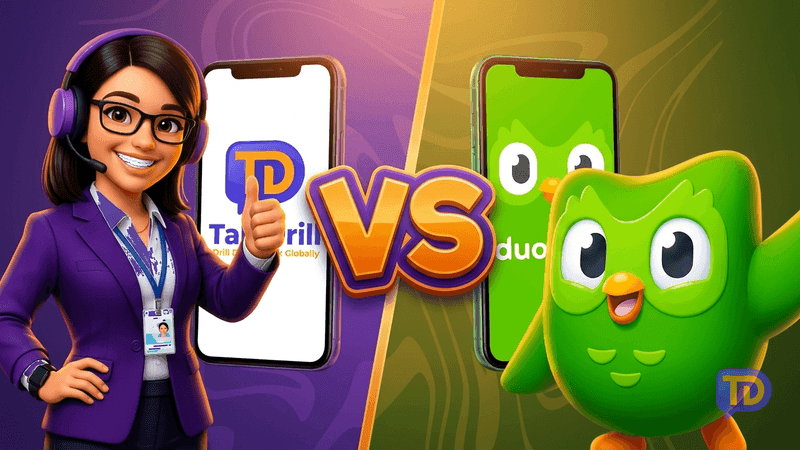

Quick Overview: Duolingo vs Cambly
Duolingo and Cambly represent two completely different philosophies of English learning. Duolingo is a free, gamified self-study app that teaches grammar, vocabulary, reading, and listening through bite-sized lessons. Cambly is a paid platform that connects you with native English tutors for live video conversations.
Comparing them directly is a bit like comparing a textbook to a conversation class — both are valuable, but for different reasons. This guide will help you understand which approach (or combination) is right for your current level and goals.
What is Duolingo?
Duolingo is the world's most popular language learning app, with more than 140 million monthly active users (Duolingo shareholder letter, Q2 2026). It offers free, gamified courses in 40+ languages. For English learners, it provides a structured path from beginner (A1) to upper-intermediate (B2).
The Duolingo Learning Model
Duolingo breaks English into hundreds of short lessons (5-15 minutes each) organized by topic and difficulty. Each lesson mixes:
- Translation exercises — translate between your native language and English
- Listening exercises — identify words and sentences from audio
- Speaking exercises — read sentences aloud for basic pronunciation checks
- Fill-in-the-blank — complete sentences with the right word or grammar form
What makes Duolingo special is its gamification. Daily streaks, XP points, leagues, achievements, and the famous green owl notifications create a powerful habit loop. Many users maintain 500+ day streaks, practicing daily without ever feeling forced.
What Duolingo Does Well
Duolingo is exceptional at building passive English skills: vocabulary recognition, grammar patterns, reading comprehension, and listening ability. Its spaced repetition algorithm ensures you review words at the optimal time for long-term retention. For the price of free, it delivers remarkable educational value.
What Duolingo Lacks
Duolingo's major weakness is active speaking practice. The "speaking" exercises ask you to read predetermined sentences aloud. The AI checks if your pronunciation is roughly correct and gives a pass/fail. In the course itself there is no spontaneous conversation, no thinking in English, no responding to unexpected questions — the skills that define real-world fluency. Duolingo's AI Video Call adds some of that, but only on the paid Max tier.
What is Cambly?
Cambly is an online tutoring platform that connects learners with native English speakers for live video conversations. Founded in 2012, it serves over 10 million learners worldwide with a unique selling point: instant access — start a lesson within seconds, no scheduling required.
The Cambly Learning Model
Cambly flips Duolingo's model entirely. Instead of app-based exercises, you have real conversations with real people. You choose a subscription by lessons per week (from 1 to 10 thirty-minute lessons) and commitment length (monthly, quarterly or annual), and either:
- Jump into an instant lesson — tap "Practice" and get matched with an available tutor in seconds
- Book a specific tutor — schedule sessions with a tutor you like
All Cambly tutors are native English speakers from the US, UK, Canada, Australia, and South Africa. The platform also offers a built-in curriculum with guided conversation topics if you prefer structured discussion over free-form chat.
What Cambly Does Well
Cambly excels at building speaking confidence. There is no substitute for actually talking to a human being, hearing natural speech, and learning to express your thoughts in real time. The instant access feature removes the biggest barrier to practice — scheduling and commitment anxiety. Between lessons, Cambly now offers a free AI practice chat (Cambly AI Chat), a progress dashboard and annotated lesson transcripts (Cambly product announcement).
What Cambly Lacks
Cambly does not teach grammar, vocabulary, or reading. It assumes you already have basic English knowledge and focuses purely on conversation practice. It's also expensive compared to self-study options — a significant barrier for learners in price-sensitive markets.
Feature-by-Feature Comparison
Learning Depth vs. Speaking Practice
This is the fundamental trade-off:
- Duolingo goes deep on knowledge — grammar rules, vocabulary breadth, reading comprehension, listening accuracy. You learn a lot about English.
- Cambly goes deep on application — using what you know in real conversations, thinking on your feet, handling the unpredictability of human interaction. You learn to use English.
Both are essential for fluency. Knowledge without practice creates someone who understands English but cannot speak it. Practice without knowledge creates someone who speaks confidently but with many errors.
Self-Paced vs. Scheduled
Duolingo is entirely self-paced. Open the app at 2am on a Sunday, do a 5-minute lesson in bed, close the app. No one is waiting. No video camera. No pressure.
Cambly requires you to be present, camera on, speaking to another person. Even with instant access, there's a social component — some learners find this motivating (accountability), others find it anxiety-inducing (especially beginners).
Cost Efficiency
The cost difference is dramatic:
| Metric | Duolingo | Cambly |
|---|---|---|
| Minimum cost | $0 (free forever) | About $37/mo (1 lesson a week, annual commitment) |
| Cost per session | $0 | $8.65-$18.75 per 30-minute lesson |
| Per hour of learning | $0 | $17.30-$37.50 |
| Annual cost | $0 (or a Super subscription, priced in the app) | About $450 and up (1 lesson a week, annual commitment) |
Cambly prices from cambly.com, checked October 2026. Duolingo wins overwhelmingly on cost. The question is whether Cambly's live conversation practice delivers enough additional value to justify paying for every lesson.
Feedback Quality
Duolingo gives instant, automated feedback on exercises — correct/incorrect with brief explanations. It is consistent but impersonal and limited to what the algorithm can detect.
Cambly gives real-time human feedback — tutors correct pronunciation, suggest better word choices, explain cultural nuances, and respond to your specific questions. The quality depends on the individual tutor, but good tutors provide feedback no algorithm can match.
Companies like Softechinfra are working on bridging this gap with AI-powered tools that deliver near-human-quality feedback at app-scale pricing — a trend reshaping how people learn to speak English.
Pricing Comparison
Duolingo Pricing
- Free: Full course access with ads and hearts (limits mistakes). Genuinely usable forever.
- Super Duolingo: a paid monthly or yearly plan (price shown in the app; it varies by country). Removes ads, unlimited hearts, mastery quizzes.
- Duolingo Max: the top tier, adding Video Call with Lily (an AI conversation partner) and Roleplay. Duolingo's help centre (checked October 2026) lists Video Call for English learners on iOS and Android, but does not list Roleplay on English for Hindi speakers. Max is bought in the app.
- Family Plan: a shared plan for up to 6 family members.
Cambly Pricing
- Free options: trial offers vary, and Cambly AI Chat (AI practice, not a tutor) is free.
- Monthly commitment: $18.75 per 30-minute lesson.
- Quarterly commitment: $12.12 per lesson.
- Annual commitment: $8.65 per lesson. You choose 1 to 10 lessons a week (cambly.com, checked October 2026).
Pros and Cons
Duolingo — Pros
- Free tier is genuinely useful — learn for years without paying a rupee
- Gamification creates daily study habits that stick
- Comprehensive skill coverage: reading, writing, listening, grammar, vocabulary
- Self-paced with zero social pressure or scheduling needs
- Scientifically designed spaced repetition for long-term retention
Duolingo — Cons
- Course speaking exercises are scripted — AI conversation (Video Call) is only on the paid Max tier
- Cannot prepare you for real-world speaking situations (interviews, meetings)
- No human interaction or personalized coaching
- Becomes repetitive at intermediate levels
- Creates a false sense of fluency — you may score well in-app but struggle to speak
Cambly — Pros
- Real conversations with native speakers build genuine speaking confidence
- Instant access means you can practice whenever motivation strikes
- Human tutors give personalized, contextual feedback
- Lesson recordings let you review and learn from past sessions
- Exposure to natural speech patterns, idioms, and cultural context
Cambly — Cons
- Expensive compared to self-study apps — about $450 a year even at one lesson a week on an annual commitment
- Does not teach grammar, vocabulary, or reading fundamentals
- Tutor quality varies — some are great teachers, others just chat casually
- Requires social interaction which can be stressful for anxious learners
- Daily lessons are possible but costly at per-lesson prices
Who Should Use Each?
Use Duolingo If You...
- Are a complete beginner who needs to learn basic vocabulary and grammar
- Want a free English learning solution with no financial commitment
- Need a daily study habit and respond well to gamification
- Prefer self-paced learning without scheduling or social pressure
- Want to build reading and listening skills alongside speaking
Use Cambly If You...
- Already know basic English and need to practice using it in conversation
- Want to improve speaking confidence and overcome hesitation
- Need exposure to native accents and natural speech patterns
- Are preparing for professional communication (meetings, presentations, client calls)
- Can afford $8.65-$18.75 per lesson for regular tutor access
User Experience Comparison
A Typical Day with Duolingo
You open the app during your morning commute. A 5-minute lesson mixes translation, listening, and fill-in-the-blank exercises on the topic of "workplace vocabulary." You earn 30 XP, maintain your 147-day streak, and feel satisfied. Total time: 5-10 minutes. Cost: free.
A Typical Day with Cambly
After work, you open Cambly and tap "Practice." Within 15 seconds, you're connected to Sarah, a tutor from California. She asks about your day, and you spend 30 minutes talking about your work project, your weekend plans, and a movie you watched. She corrects your grammar in real time, teaches you three new idioms, and suggests better word choices for professional contexts. You feel nervous at first but end the session buzzing with confidence. Total time: 30 minutes. Cost: $8.65-$18.75, depending on your commitment.
Which Experience Builds Fluency?
Both contribute, but differently. Duolingo builds the foundation (you need to know words and grammar before you can speak). Cambly builds the application (you need to practice speaking to become fluent). Most language experts agree that active speaking practice is the faster path to fluency once you have a basic foundation — but that foundation is essential.
Indian English Learner Perspective
For Indian learners, the choice between Duolingo and Cambly often comes down to budget and stage:
Stage 1: Building Foundations (Use Duolingo)
If you studied in a Hindi-medium or regional language-medium school and need to build English vocabulary and grammar from scratch, Duolingo is the perfect starting point. It's free, available in Hindi, and teaches systematically. Spend 3-6 months here building your base.
Stage 2: Speaking Practice (Consider Cambly or Alternatives)
Once you can form basic sentences and understand everyday English, you need speaking practice. Cambly's lessons cost $8.65-$18.75 each (USD prices on cambly.com) — affordable for some IT professionals but a stretch for students. Alternatives include language exchange apps (free but unreliable) and AI conversation apps (affordable and available 24/7).
For Indian learners looking to improve their writing alongside speaking, platforms like PenLeap offer AI-powered writing feedback that complements both Duolingo's vocabulary building and Cambly's speaking practice — especially useful for students preparing for competitive exams where both skills matter.
Our Verdict
Start with Duolingo if you are a beginner — it builds the vocabulary and grammar foundation you need before conversation practice makes sense.
Add Cambly (or speaking practice) once you can form basic sentences — this is where real fluency growth happens.
The gap: at per-lesson prices, most budgets stretch to only a few Cambly lessons a week, while speaking improves fastest with daily practice. Neither Duolingo nor Cambly alone provides affordable daily conversation practice.
Looking for Something Different?
The ideal English learning stack combines Duolingo's gamified knowledge-building with Cambly's real conversation practice. But there is a gap: Duolingo doesn't offer real conversations, and Cambly is too expensive for daily practice.
TalkDrill bridges this gap with AI-powered conversation practice. For daily practice you talk with AI tutors, available 24/7 at a fraction of the cost of a lesson (about 30 minutes a day on Pro, ₹299 a month). The AI corrects grammar, suggests vocabulary, provides pronunciation feedback, and even simulates job interviews. When you want a person, you can book 1:1 sessions with verified human tutors (Pro+ includes 4 a month), and for the Duolingo side there are two short Learn courses in grammar basics and everyday spoken English.
Think of it as: Duolingo for knowledge (free), TalkDrill for daily conversation practice (affordable), and Cambly for native speaker interaction (premium). The three together cover every skill at a reasonable total cost.
Frequently Asked Questions
Quick answers to common questions about Duolingo vs Cambly.