

Before You Begin
Read these few pages first. They show you how the book works, who you will meet in it, and where your own gap is widest.
Who this book is for
You read English without much trouble. You follow films, videos and meetings. You may write good emails. Then someone asks you a simple question, face to face, and the English disappears. You answer with three words when you had thirty in your head. Later, when you are alone, the right answer arrives.
If that is you, this book was written for you.
Teachers describe your level as B1 or B2. That means intermediate: you are past the basics, but speaking is not yet comfortable. You probably studied English for years. You may know the grammar rules better than some people who speak easily. You don’t need more knowledge. You need practice in one specific skill: getting English out of your mouth at the speed of a conversation.
Nothing is wrong with you. This gap is the normal result of the way most people learn English, with a lot of reading, listening and tests, and very little speaking. Chapter 1 explains exactly why it happens.
Who this book is not for
This book is not for complete beginners. If you can’t yet follow a slow, simple conversation or read a short news story, start with a general English course and come back later. The book gives you tools for using the English you already have. It does not teach basic grammar or first vocabulary.
It is also not a book to read quietly and put away. Reading about speaking does not make anyone speak. Half of the value is in the exercises, and they only work if you do them out loud.
How the book works
The book has three parts.
- Part One: Understand the Gap (Chapters 1 to 3) explains why you freeze, which habits keep you silent, and how fluent speakers really speak.
- Part Two: The Tools (Chapters 4 to 8) gives you five tools: ready-made phrases called chunks, phrases that buy you time to think, a four-move structure for any answer, simple sentences, and clear pronunciation.
- Part Three: Make It Automatic (Chapters 9 to 12) turns the tools into habits. You practice alone first, then in real conversations, and you learn what to do when the fear comes back.
Chapter 12 holds the 21-day plan: three weeks, 15 minutes a day, one clear task each day. The plan uses the tools from Chapters 4 to 10, so read those chapters before you start it. Do the short exercises as you read. Then begin day 1.
Every chapter has the same shape. It opens with a short scene from a learner’s life. Then comes the teaching, with many example sentences. One or two “Try it now” boxes ask you to speak immediately. A Practice section and a short summary close the chapter.
At the back you will find the Answer Key, a Phrase Bank with the most useful phrases from the whole book, a one-page Rescue Card for the moment you freeze, and a progress tracker.
Three learners you will get to know
Three people appear in every part of this book. Each of them has the gap in a different form.
Priya is 27 and works as a software tester in Bengaluru, India. In meetings she understands everything, but when her manager asks for her opinion, her mind goes blank. She builds each sentence in her first language and translates it word by word, so her answer is always late.
Diego is 34, a nurse from Medellín, Colombia, who is preparing to work in Toronto, Canada. He reads medical English very well. On the phone and in small talk he gets nervous and speaks too fast. Then he can’t find a word, and he stops completely.
Mei is 22, an engineering student in Ho Chi Minh City, Vietnam, with a scholarship interview ahead of her. Her written grammar is excellent. When she speaks, she waits for the perfect sentence and corrects herself so often that listeners can’t follow her.
You will probably see yourself in one of them, or a little in all three. They do not become perfect speakers by the last page. They get better step by step, and so will you.
The 15-minute rule
This book has one rule: speak English out loud for 15 minutes every day.
Fifteen minutes a day is better than two hours every Sunday, even though two hours is more time. Here is why.
Speaking is a physical skill. Your mouth, your breath and your memory have to work together, and quickly. Skills like that grow through many short repetitions. Think of someone learning the guitar. Ten minutes every evening trains the fingers. One long lesson a month does not.
Memory fades between sessions. When you say a phrase today and again tomorrow, the second time is a little faster. Say it again the day after, and it starts to come without effort. If you leave a week between sessions, much of that speed is gone. You spend the next session getting back to where you were.
Fear gets smaller with contact. If you hear your own voice speaking English every day, it becomes an ordinary thing. If you speak once a week, every time feels like a test.
You can keep the promise. Even on a bad day you can find 15 minutes: before breakfast, on a walk, while you cook. A two-hour session is the first thing you cancel when life gets busy.
How to use the exercises
Always out loud. Silent practice trains understanding, which is the skill you already have. Whisper only when other people are near. The rest of the time, use your normal voice, as if someone were sitting across the table. If you share your home, find a place where you feel free to talk: a walk outside, the car, the balcony, the bathroom.
Keep your phone near you to record yourself. Many exercises ask for a recording. Almost nobody likes the sound of their own voice at first. Record anyway, because a recording shows you things you can’t hear while you are speaking: where you stopped, where you rushed, which words were unclear. Listen once, for the one thing the exercise names. Do not judge your accent. A few exercises ask you to keep a recording so that you can compare it later. You may delete all the others.
Keep a small notebook. Choose one that fits in a pocket or a bag. In Chapter 4 it becomes your chunk notebook, the place where you collect useful phrases that you hear and want to say yourself. For now, just have it ready. A notes page on your phone also works, if you will really open it.
Check your answers at the back. Written exercises have right answers in the Answer Key. Finish the whole exercise before you look. Speaking drills have model answers. A model answer is one good answer, not the only one. Yours will be different, and that is fine.
Do each “Try it now” box when you reach it. These tasks take one or two minutes. If you are reading on a bus or in a waiting room, mark the page and do the task at home, before you read further.
Where is your gap? A self-check
Before Chapter 1, measure your starting point. Read each statement and think about the last few months. Tick 0 if this never happens to you, 1 if it sometimes happens, and 2 if it often happens. Be honest. Nobody else will see this page.
| # | Statement | 0 | 1 | 2 |
|---|---|---|---|---|
| 1 | I build a sentence in my first language and then translate it into English. | ☐ | ☐ | ☐ |
| 2 | When my sentence is finally ready, the conversation has moved to another topic. | ☐ | ☐ | ☐ |
| 3 | My mind goes blank when someone asks me a question I did not expect. | ☐ | ☐ | ☐ |
| 4 | When I can’t find a word, I stop speaking. | ☐ | ☐ | ☐ |
| 5 | I stay silent because I am not sure my grammar is correct. | ☐ | ☐ | ☐ |
| 6 | I correct myself in the middle of a sentence and start it again. | ☐ | ☐ | ☐ |
| 7 | I give very short answers, such as “Yes” or “It’s fine”, when I have much more to say. | ☐ | ☐ | ☐ |
| 8 | I speak too fast when I am nervous, and people ask me to repeat. | ☐ | ☐ | ☐ |
| 9 | I worry about what people will think of my English or my accent. | ☐ | ☐ | ☐ |
| 10 | I avoid phone calls in English and send a message when I can. | ☐ | ☐ | ☐ |
| 11 | In meetings or classes, I have an idea but I do not say it. | ☐ | ☐ | ☐ |
| 12 | After a conversation, I think of all the things I could have said. | ☐ | ☐ | ☐ |
Now add up your ticks. Each tick in the “1” column is one point, and each tick in the “2” column is two points. Your total is between 0 and 24.
What your score means
| Score | What it means | Where to focus first |
|---|---|---|
| 0–8 | A small gap. You speak in most situations, and only a few of them block you. | Read Part One quickly. Then look at the statements where you ticked 2 and go to the chapters in the next table. |
| 9–16 | A clear gap. You can speak, but you say much less than you think. This is the reader we had most in mind. | Read the book in order. Give extra time to Chapters 4 and 5, which help with almost every statement on the list. |
| 17–24 | A wide gap. Speaking feels hard in most situations. This is common after years of reading and listening with little speaking, and it can change. | Go slowly. Read Chapters 1 and 2, then work on Chapters 4, 5 and 9. Chapter 9 lets you practice alone, with no listener, before the real conversations in Chapter 10. |
What your highest statements tell you
The total is only half of the picture. Look again at the statements where you ticked 2. They show which tools you need most.
| If you ticked 2 for | Your gap is mostly about | Give extra time to |
|---|---|---|
| 1, 2 | translating in your head | Chapter 4 |
| 3, 4 | freezing and missing words | Chapter 5 |
| 5, 6 | waiting for the perfect sentence | Chapters 3 and 7 |
| 7, 12 | saying less than you think | Chapter 6 |
| 8 | speed and clear speech | Chapter 8 |
| 9 | fear of being judged | Chapter 11 |
| 10, 11 | calls and meetings | Chapter 10 |
Write today’s date and your score on the first page of your notebook. After day 21 of the plan, come back to this page. Cover your old ticks with a piece of paper and take the self-check again.
Do not expect a score of zero. Expect some of your 2s to become 1s, and some of your 1s to become 0s. A change like that means you are speaking in situations where you used to stay silent. That is the result this book is built to give you.
Chapter 1: Why You Freeze
Chapter 1
Why You Freeze
After this chapter you will be able to explain what happens in your head when you freeze, and why practice can change it.

- Understanding (recognition) and speaking (production) are different skills, and most learners trained only the first.
- The translation loop has four steps: think in your first language, translate, check the grammar, speak.
- The loop is too slow for conversation, and it also stops you listening, makes your answers short and produces strange English.
- On the direct route, an idea goes straight to a ready-made English phrase, as it already does when you say “Thank you”.
It is 10:15 on a Tuesday morning in Bengaluru. Priya sits at a long table with six other people from her team. This is the sprint meeting, where the team plans its next two weeks of work. Today’s question is whether a new payment screen can go to customers on Friday.
Priya has tested that screen for nine days. She knows it better than anyone in the room. She also knows it is not ready, because the login error she found last week is still there.
Then her manager turns to her. “What do you think, Priya?”
Everyone looks at her. Her heart beats faster. The answer is clear in her head, in her first language. She starts to turn it into English. Should it be “should not release” or “must not release”? Is “bug” too informal for this room? Four seconds pass. Five.
“It’s fine, I think,” she says.
Her manager nods and turns to the next person. Two minutes later a colleague says, “I don’t think we should release on Friday. The login bug isn’t fixed.” Everyone agrees. It was Priya’s idea, and it was Priya’s bug.
She understood every word of that meeting. She had the right answer. She still could not say it in time. Perhaps you know this moment from a meeting, a class, a shop or a phone call. This chapter explains what happened in it.
Understanding and speaking are two different skills
Many learners believe something like this: “If I understand English, I should be able to speak it. I can’t, so something is wrong with me.” The first sentence is false, so the second one is false too.
Understanding and speaking use your English in opposite directions.
When you listen or read, the English arrives from outside. The word is already in front of you, and you only have to match it with a meaning. This skill is called recognition.
When you speak, nothing arrives. You start with an idea. You must find the words yourself, put them in order and pronounce them, all within a second or two. This skill is called production.
Recognition is easier than production in every area of life. You recognize a neighbor’s face at once, but you may not remember his name. You know a song when you hear it, but you can’t sing all the words alone.
- The part of your arm that bends in the middle.
- The piece of paper a shop gives you after you pay.
- The top surface of a room, above your head.
Now read these three words: elbow, receipt, ceiling. You knew all of them the moment you saw them. Finding them yourself was slower, and perhaps one did not come at all.
Those three words were in your memory the whole time. Producing them is a separate ability, and it needs separate training.
Now think about how you learned English. Count the hours you spent reading, listening, doing grammar exercises and preparing for written tests. All of that trained recognition. Then count the hours you spent speaking in full sentences, about your own ideas, with someone waiting for your answer. For most learners the second number is very small.
So the gap is no mystery. You trained one skill for years and the other for a few hours. One is strong and the other is weak, as anyone would expect.
The translation loop: why your answer arrives late
Go back to Priya at the table. She did four things in her head before she could open her mouth.
- Think in the first language. She formed the complete answer in the language she grew up with.
- Translate. She looked for an English word for each word of that sentence.
- Check the grammar. She tested the tense, the word order and small words such as “the” and “since”.
- Speak. Only then was she ready to say it.
We call this the translation loop. A loop is a path that goes around and comes back to where it started. When the check in step 3 finds a problem, you go back to step 2 and try again.
School taught you the loop, and it works well for writing. When you write an email, nobody watches you think. You can take two minutes for one sentence.
A conversation doesn’t give you two minutes. People expect an answer to begin almost at once. A silence of one second feels normal. A silence of four or five seconds feels very long, to you and to the listener. Each step of the loop takes time, and step 3 can send you around again. The loop can’t finish before the silence becomes uncomfortable.
The loop has three more costs.
It stops you listening. Your attention is busy inside your head, so you miss what the next person says. Then you are lost.
It makes you say less. Each sentence costs so much work that you choose the shortest possible answer: “Yes.” “No problem.” “It’s fine.” The people around you hear someone with few ideas. In fact you have many ideas and a slow way of getting them out.
It produces strange English. Languages do not match word for word. When you translate each word, you often get English words in the order of another language. Here are some sentences that the loop produces, next to what fluent speakers say.
| Instead of | Try |
|---|---|
| I am agree with you. | I agree with you. |
| I have 27 years. | I’m 27. |
| Please explain me the problem. | Can you explain the problem? |
| How do you call this in English? | What do you call this in English? |
| I am working here since three years. | I’ve worked here for three years. |
The people who say the sentences on the left are not bad at English. Each sentence is a careful translation of a correct sentence in another language. The problem is the method.
The direct route: English that is ready before you need it
There is another way from an idea to a spoken sentence, and you already use it.
Someone hands you a coffee. You say “Thank you.” You did not form the phrase in your first language, translate it and check the grammar. The idea and the English came together. The same is true for sentences like these:
- Nice to meet you.
- I don’t know.
- See you tomorrow.
- Sorry I’m late.
- No problem.
We call this the direct route. The idea goes straight to an English phrase, and the phrase goes straight out. There is no step 2 and no step 3. The phrase is stored in your memory as one finished piece. You have said it so many times that it needs no building.
Fluent speakers are not faster translators. They don’t translate at all. They have thousands of these finished pieces, and they join them together as they speak. Chapter 4 calls the pieces chunks and shows you how to collect them.
Look again at what Priya’s colleague said: “I don’t think we should release on Friday. The login bug isn’t fixed.” It sounds like a clever answer. It is really two ready-made frames with a few words added:
- I don’t think we should … (release on Friday / change the plan / wait any longer)
- The … isn’t fixed. (login bug / printer / problem with the invoices)
Imagine that “I don’t think we should” had been as ready in Priya’s memory as “Thank you”. She would have needed to add only three words of her own. That takes about a second, and her manager was waiting for exactly that long.
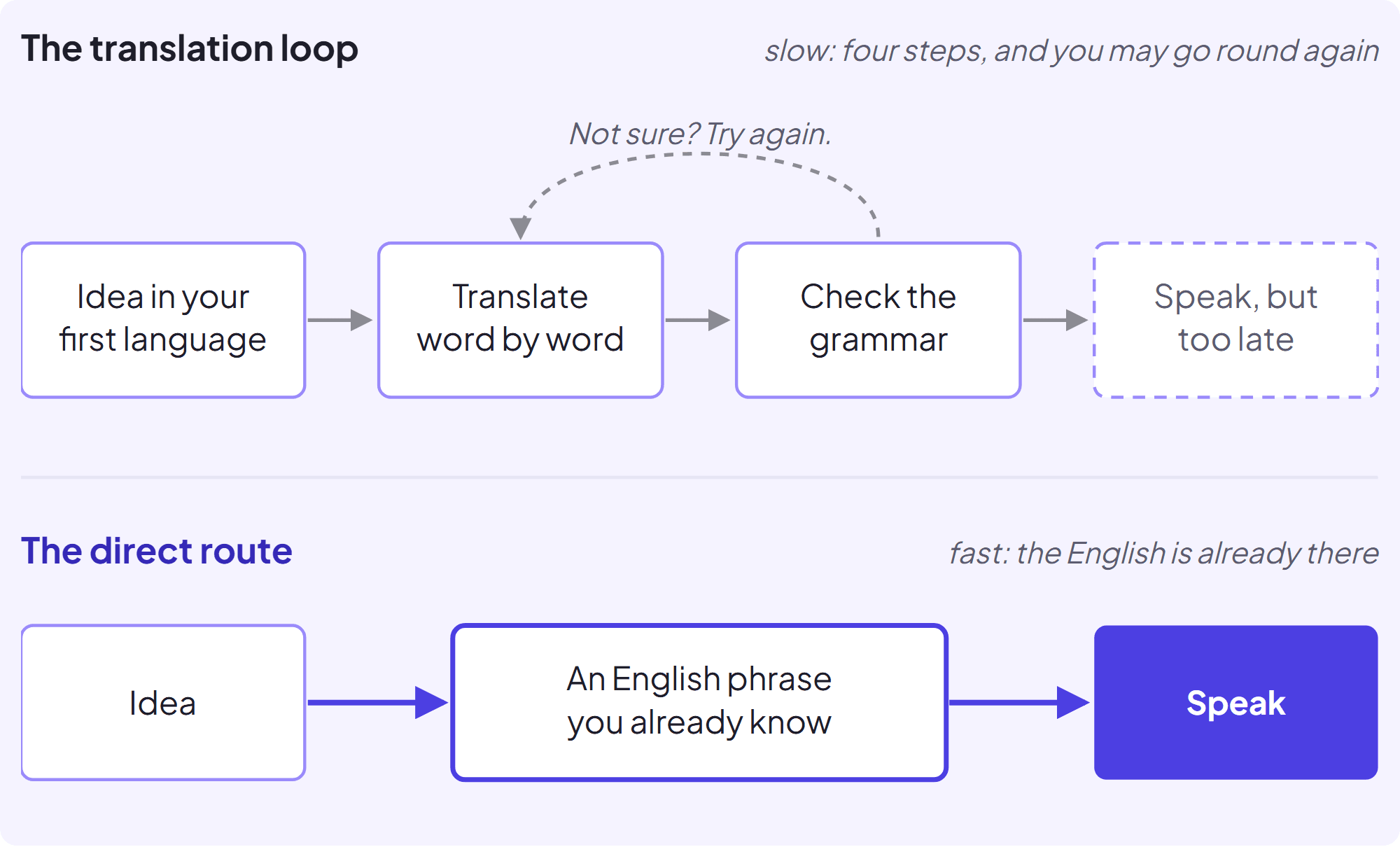
The loop has four steps and can send you back to try again. The direct route has one arrow.
- What’s your name?
- How are you today?
- Where do you live?
- What did you eat this morning?
- Should children have a phone before the age of twelve?
Notice the difference. The first three answers probably came by the direct route, because you have said them many times. The last two probably started the loop. Your English did not change between question 3 and question 4. Only the route changed.
The fear filter: why you lose even the English you have
The loop explains a late answer. It does not explain everything. Sometimes you lose a word you have known for ten years. Sometimes you can’t finish a sentence that you could easily write. Something else is at work.
Diego knows this well. He is a nurse from Medellín, and he is preparing to work in a hospital in Toronto. Last month he had a video call with a recruiter, a person who finds staff for hospitals. He had prepared answers about his nursing experience. Her first question was about something else.
Recruiter: Hi Diego, good to see you. How was your weekend?
Diego: Good, good, thank you, it was very good, I was with my family and we went to, we made a… a…
Recruiter: Take your time.
Diego: A party. For my… the son of my sister. He is…
Recruiter: Your nephew? Oh, nice. How old is he?
Diego: Yes. Nephew. He is… Sorry. My English is not good today.
Recruiter: No, you’re doing fine. So, shall we talk about the job?
Diego: Yes. Please.
Diego knows the word “nephew”. He knows the boy is six. He lost both because part of his mind was busy with other thoughts: “She thinks my English is too weak for this job. She noticed that mistake. I’m speaking too fast.”
We call this the fear filter. A filter lets some things pass and stops others, like the paper in a coffee machine. When you are afraid of being judged, the worry uses a large part of your attention. Less attention is left for finding words. English that you really know gets stopped before it reaches your mouth.
You can see that fear is the cause, because the English comes back when the fear goes away. Ten minutes after the call, Diego said the whole answer to himself in the kitchen: “We had a birthday party for my nephew. He turned six.” Perhaps you know this too. The best sentences come in the shower or on the way home, when nobody is listening.
The fear filter and the translation loop make each other stronger. The loop makes you slow. Slowness creates a silence. The silence makes you nervous, and nervousness blocks more words. The loop gets even slower.
Mei shows another form of the same problem. Her written grammar is excellent, and she expects her speech to be as correct as her writing. So she checks every sentence while she is saying it: “Last year I have joined… I joined… I had joined a robotics team.” Step 3 of the loop never switches off, because she is afraid of one wrong tense. Most listeners would not care about the tense. They do notice that the sentence started three times.
Speaking is a skill, and skills can be trained
Think about the first time you drove a car, rode a motorbike or typed on a keyboard. Every action needed thought. You searched for each letter. You thought about each pedal and each mirror. You were slow, and you could not talk at the same time.
A few months later your hands did the work alone. You could type while you were thinking about what to say. You could drive and talk to a passenger. You did not become more intelligent in those months. You repeated the same actions until they no longer needed your attention.
Speaking English works the same way. At the moment, too much of your speaking goes through the slow, careful route. Training moves it to the fast route, one phrase at a time. You learn by saying useful phrases out loud, many times, until they are as ready as “Thank you”.
This also changes what your past means. Years of freezing show that the skill was never trained. They do not show that you can’t learn it.
Imagine Priya’s Tuesday meeting again, this time with a few of those tools.
| Instead of | Try |
|---|---|
| It’s fine, I think. | Let me think for a second. I don’t think we should release on Friday. The login bug isn’t fixed yet. |
Nothing in the second answer is advanced English. Priya has known every word in it for years. The pieces were simply not ready when she needed them. She is not there yet, and the next chapters show how she begins.
Before you train, you need to know your own pattern. Priya translates. Mei waits for the perfect sentence. Diego stops when a word is missing. Most learners have a little of all three habits, but one is usually the strongest. Chapter 2 looks at each habit closely and helps you find yours.
Practice
Exercise 1 · Recognition or production?
Write R if the activity trains recognition (understanding). Write P if it trains production (speaking).
- Watching a film in English with subtitles.
- Leaving a voice message for a colleague.
- Reading a news article.
- Explaining to a tourist how to get to the station.
- Describing your weekend to a friend on a call.
- Choosing the correct word from a list to complete a sentence.
Exercise 2 · Fill the gap
Complete the sentences with these words. Use each word once: attention, direct, fear, grammar, production, recognition, repetition, translate.
- Understanding a word when you read it is .
- Finding a word yourself when you speak is .
- In the translation loop, you think in your first language, then you , then you check the , and only then do you speak.
- “Thank you” and “See you tomorrow” come out by the route.
- The filter blocks words that you really know.
- While you are translating in your head, you have little left for listening.
- A slow action becomes automatic through .
Exercise 3 · What is happening?
Read each situation. Choose A (the translation loop), B (the fear filter) or C (the direct route).
- A stranger asks Samira the time. She says “It’s half past four” without thinking.
- Tomás wants to say that he agrees. He says “I am agree”, because his first language uses the verb “to be” in this sentence.
- Ana knows the word “invoice” well. In a call with an important client she can’t find it. After the call it comes back at once.
- Kenji prepares a full sentence in his first language. When the English version is ready, the group is talking about something else.
- Fatima speaks English easily with her sister. She says almost nothing when her teacher is in the room.
Exercise 4 · Three times, faster
Take three minutes. Say each sentence out loud three times: first slowly, then at normal speed, then without looking at the page. Then record all five sentences once.
- I don’t think we should do that yet.
- Let me think about that for a second.
- I’m not sure, but I think so.
- Can I add something?
- That’s a good point, but I see it differently.
Exercise 5 · Your starting point
Set a timer for 60 seconds and start recording. Answer this question out loud: “What did you do yesterday?” Keep talking until the timer stops. Do not stop to correct mistakes, and do not record it a second time. Save the recording with today’s date. It is your starting point, and you will want to compare it with a later one.
Chapter summary
- Understanding (recognition) and speaking (production) are different skills, and most learners trained only the first.
- The translation loop has four steps: think in your first language, translate, check the grammar, speak.
- The loop is too slow for conversation, and it also stops you listening, makes your answers short and produces strange English.
- On the direct route, an idea goes straight to a ready-made English phrase, as it already does when you say “Thank you”.
- The fear filter is the worry about being judged, and it blocks even words that you know well.
- Speaking is a skill like typing or driving, and repeating useful phrases out loud is what makes it automatic.
Answers
Exercise 1
- R
- P
- R
- P
- P
- R
Exercise 2
- recognition
- production
- translate, grammar
- direct
- fear
- attention
- repetition
Exercise 3
- C
- A
- B. The word returned when the pressure was gone.
- A
- B. Her English is the same in both situations.