
Exploring the wonders of the night sky
An article about stargazing destinations and the beauty of the cosmos.
An intermediate-level session of about 3 minutes. A 110-word passage, scored word by word.
This is a descriptive passage rather than an explanatory one, and it asks for more expression than the other science texts here. Writing about the night sky tends towards longer, looser sentences with several phrases strung together, so the question is not where the full stops fall but how many phrases you can carry in one breath before the line goes thin. Two or three is usually right. The second demand is contrast: place names and the occasional astronomical term sit inside otherwise everyday sentences and need clean enunciation without becoming the loudest thing in the line. At intermediate level nobody is expecting a performance. A steady, warm reading that eases slightly on the descriptive stretches is what a good attempt sounds like.
Angles worth taking
- Group the phrases two or three to a breath; a long descriptive sentence taken on one lungful runs out before its ending.
- Ease the pace on the descriptive stretches and return to normal for the factual ones — that difference is the expression.
- Say place names and astronomical terms at ordinary volume, since clarity is what is wanted from them, not emphasis.
- Let the pitch fall properly at each full stop, or a run of descriptions blurs into a single undifferentiated list.
- Read it warmer than an informative article and well short of dramatic; this text does not need to be performed.
How the passage opens
On a clear night, far from the city lights, the sky transforms into a breathtaking canvas of stars, planets, and distant galaxies. Stargazing has captivated humans for millennia, from ancient navigators who charted their courses by the constellations to modern…
Ready to speak?
Part of Pro. You need a TalkDrill account on a Pro plan to speak — reading this page does not.
Browse all read-aloud passagesThe format
Passage length
110 words
Modes
Learn (guided) · Mock (exam-real)
How a read-aloud session works
Pick a passage
Passages are graded from short and simple to long and dense. The length and the level are on every card.
Read it aloud
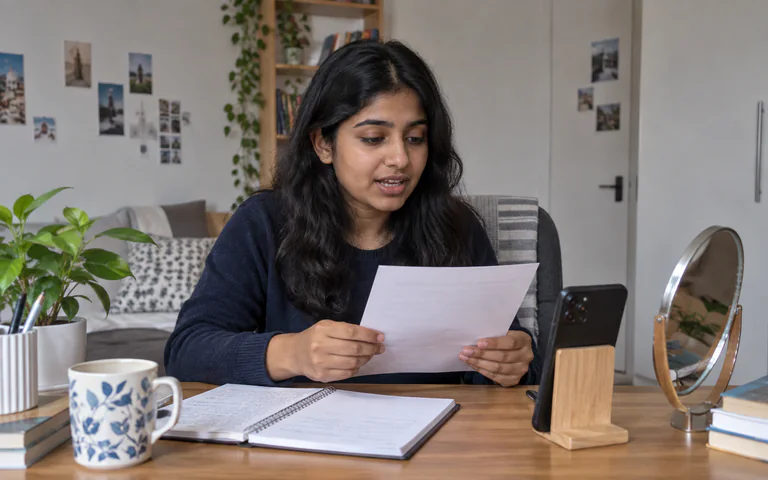
The text stays on screen while you record. Read at a normal pace — rushing to finish is itself one of the things being measured.
See it marked up
Every word comes back scored: accurate, unclear, or missed. The problem sounds are highlighted where they occurred.
Re-record the hard line
Go back to the sentence that scored worst and read it again. That single loop is where most of the improvement happens.
What you're scored on
A read-aloud report has four numbers, and knowing which one is low tells you what to practise — they are not interchangeable.
Read clearly with proper pronunciation of scientific terms.
Accuracy
How close each word was to the expected pronunciation, scored per word rather than averaged into one verdict.
Fluency
Pace and pausing. Pausing at commas reads as fluent; pausing mid-phrase to decode the next word does not.
Completeness
The words that never arrived — skipped articles, dropped past-tense endings, swallowed plurals.
Prosody
Stress and intonation: whether the sentence lands with emphasis in the right place, or flat from end to end.
More read-aloud passages




All read-aloud passages · Science passages · All speaking practice