

Introduction
“The mistakes that survive longest are the ones nobody corrects, because everyone around you makes them too.”
The errors in this book are not beginner errors. They belong to people who speak English every day, confidently, at work and at home - which is exactly why they have survived. Nobody corrects them, because everybody in the room is making the same one.
Each card opens with the mistake written the way it is actually spoken, gives you the corrected sentence and the rule in one line, and then explains where the error comes from. Most of them are not carelessness at all: they are a sentence carried faithfully across from Hindi, Tamil, Bengali or Marathi, or a school rule that was taught only half way.
Nothing here is about sounding British. It is about not being quietly marked down in an interview, an email, or a first meeting.
How to use this book
- Read the wrong sentence out loud first. If it sounds normal to you, that is the one to learn.
- Say the correction out loud three times. Reading it silently will not move it into your speech.
- Take one chapter a week and catch yourself in real conversations.
- Do not try to fix everything at once - pick the five that you personally say most.
- Come back to the quiz a week later, not the same day.
Chapter 1
Tenses That Go Wrong in Speech
You already know these tenses on paper, but a handful of them slip out wrong every single day, and this chapter catches them one by one.
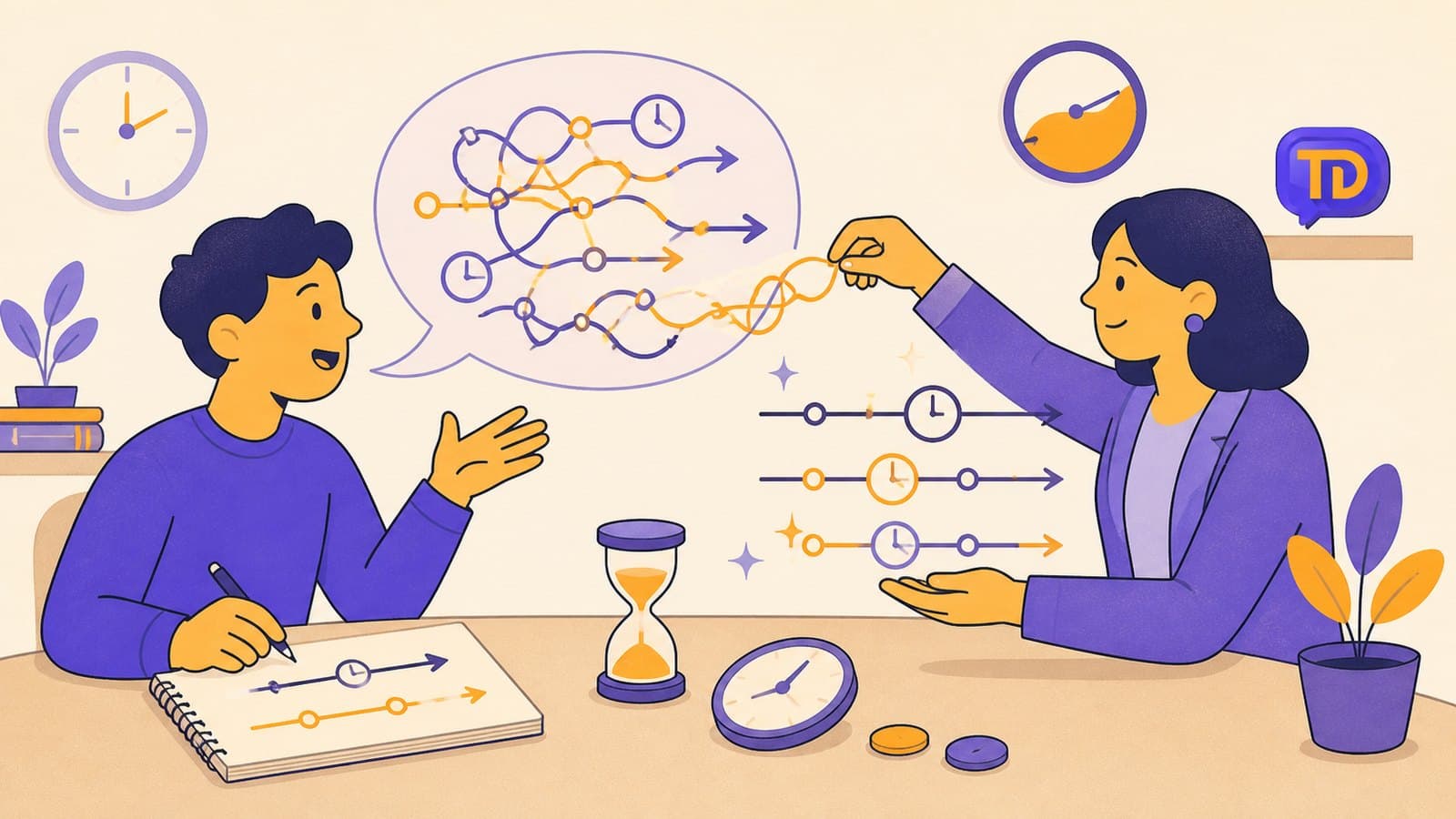
- Stop adding -ing to verbs that describe a state
- Choose between the present perfect and the past simple with confidence
- Say how long you have been doing something without breaking the tense
- Use since and for with the tense each one needs
- Repair the eight or nine sentences you repeat most often
I am having two brothers.
Say this instead
'I have two brothers.' Have in the sense of owning, possessing or being related to somebody never takes the -ing form.
The correct form in use
Introducing your family to a colleague
“I have two brothers, and both of them work in Bengaluru.”
Asking a friend for something
“Do you have a spare charger in your bag?”
Also wrong: Also wrong: 'I am having a car and a bike.' Note that 'I am having lunch' is perfectly correct, because there have means eating, which is an action, not a possession.

I am not knowing his number.
Say this instead
'I do not know his number.' Know describes a state in your mind, so it stays in the simple present and takes do or does in the negative.
The correct form in use
Telephone conversation at work
“I do not know his number, but I can ask the office to share it.”
Giving directions with a friend
“She knows this area very well, so let us follow her.”
Also wrong: Also wrong: 'I am knowing that shop near the metro station.'
Are you understanding my point?
Say this instead
'Do you understand my point?' Understand describes a mental state, so questions about it use do or does, not the continuous.
The correct form in use
Explaining a process to a teammate
“Do you understand my point, or should I explain it once more?”
Responding in a review meeting
“I understand the problem now, thank you for repeating it.”
Also wrong: Also wrong: 'I am not understanding what he is saying.'
I am not remembering her face.
Say this instead
'I do not remember her face.' Remember and forget describe states of memory, so they stay in the simple present.
The correct form in use
Talking about an old classmate
“I do not remember her face, but I remember her voice clearly.”
Searching for something at home
“He does not remember where he kept the keys.”
Also wrong: Also wrong: 'I am forgetting his name every time.'
This chai is tasting very nice.
Say this instead
'This chai tastes very nice.' Verbs of the senses such as taste, smell, look, sound and seem describe a quality, so they use the simple present.
The correct form in use
Tea break at the office
“This chai tastes very nice, much better than the one downstairs.”
Visiting a friend's home
“Your new flat looks bigger in person than in the photos.”
Also wrong: Also wrong: 'The food is smelling very good.' Note that 'She is tasting the curry' is correct, because there tasting is a deliberate action.

I am needing your help right now.
Say this instead
'I need your help right now.' Need, want and prefer describe states of desire and never take the -ing form, even when the need is urgent.
The correct form in use
Asking a colleague urgently
“I need your help right now, the client call starts in ten minutes.”
Booking a bus ticket
“I prefer the window seat if it is still available.”
Also wrong: Also wrong: 'I am wanting one more day to finish this.'

I am belonging to Coimbatore.
Say this instead
'I am from Coimbatore.' Belong describes a permanent relationship, so it never takes -ing, and for your hometown the natural English sentence uses am from.
The correct form in use
Introducing yourself to a new team
“I am from Coimbatore, but I have been in Pune since my first job.”
Returning a lost item
“This umbrella belongs to the lady at the reception desk.”
Also wrong: Also wrong: 'I am belonging to a small town near Nashik.'

I have gone to Manali last year.
Say this instead
'I went to Manali last year.' Once you name a finished time such as last year, yesterday or in December, the sentence must use the past simple.
The correct form in use
Talking about a holiday
“I went to Manali last year and the roads were beautiful.”
Same trip, but with no time mentioned
“I have been to Manali twice, so I can plan the route for you.”
Also wrong: Also wrong: 'Yesterday I have spoken to the manager about it.'

I have completed my graduation in 2019.
Say this instead
'I completed my graduation in 2019.' A specific year is a finished time, so the past simple is the only correct choice here.
The correct form in use
Answering an interview question
“I completed my graduation in 2019 and joined my first company that August.”
Same verb, correct present perfect, no time named
“I have completed the assignment, so you can review it whenever you are free.”
Also wrong: Also wrong: 'I have joined this company in March 2021.'

When have you joined this company?
Say this instead
'When did you join this company?' A question that begins with when is asking about a finished point in time, so it takes the past simple with did.
The correct form in use
Small talk with a colleague
“When did you join this company, before or after the new office opened?”
Asking about duration instead of a starting point
“How long have you been with this company?”
Also wrong: Also wrong: 'When have you reached Delhi?'

I have never went to Goa.
Say this instead
'I have never been to Goa.' After have or has, English needs the past participle, so went becomes been or gone.
The correct form in use
Planning a holiday with friends
“I have never been to Goa, so this trip will be my first.”
Choosing a place for dinner
“She has never eaten at that restaurant, but she has heard good things.”
Also wrong: Also wrong: 'I have already ate my lunch.'
Did you ever try Kashmiri food?
Say this instead
'Have you ever tried Kashmiri food?' When you ask about experience at any time up to now, with no finished time in the sentence, use the present perfect.
The correct form in use
Choosing a dish for a guest
“Have you ever tried Kashmiri food, or should I order something safer?”
Same verb, correct past simple, because the time is finished
“Did you try the Kashmiri food at the wedding last week?”
Also wrong: Also wrong: 'Have you ever ate Kashmiri food?'
I am working in this company since 2019.
Say this instead
'I have been working in this company since 2019.' When an action started in the past and is still going on, use the present perfect continuous, not the present continuous.
The correct form in use
Telling a new colleague about yourself
“I have been working in this company since 2019, mostly on the support team.”
Describing a neighbour
“He has been living in this building since his transfer.”
Also wrong: Also wrong: 'I am staying in this PG since April.'

I am waiting for you since one hour.
Say this instead
'I have been waiting for you for an hour.' A stretch of time takes for and the present perfect continuous, because the waiting began earlier and has not stopped.
The correct form in use
Meeting a friend who is late
“I have been waiting for you for an hour, is everything all right?”
Same idea, with a starting point instead of a duration
“We have been waiting since three o'clock, so the queue should move soon.”
Also wrong: Also wrong: 'It is raining since morning.' Say 'It has been raining since morning.'

I know her since 2015.
Say this instead
'I have known her since 2015.' With a state verb such as know, the -ing form is not available, so the duration is carried by the present perfect simple.
The correct form in use
Explaining how you know somebody
“I have known her since 2015, we met during our first internship.”
Another state verb with a duration
“They have had that shop for twenty years.”
Also wrong: Also wrong: 'I am knowing her since 2015.'
Chapter 1 check
Read each situation and choose the sentence that a careful speaker would actually say.
Choose the correct way to talk about the size of your family.
I am having two brothers.I have two brothers.I am have two brothers.I having two brothers.Reveal answer to 1
I have two brothers. — Have in the sense of possession or relationship never takes the -ing form.
A friend asks for a phone number that you cannot recall. What do you say?
I am not knowing it.I am not know it.I do not know it.I not knowing it.Reveal answer to 2
I do not know it. — Know describes a mental state, so the negative is formed with do not and the simple present.
Pick the correct question for checking that your listener is following you.
Are you understanding me?Are you understand me?You are understanding me?Do you understand me?Reveal answer to 3
Do you understand me? — Understand is a state verb, so its question form uses do rather than the continuous.
You visited Manali in December, and the trip is over. Which sentence reports it correctly?
I have gone to Manali in December.I have went to Manali in December.I went to Manali in December.I am going to Manali in December.Reveal answer to 4
I went to Manali in December. — A finished time expression such as in December forces the past simple.
Your degree finished in a stated year. Which sentence is correct?
I have completed my graduation in 2019.I completed my graduation in 2019.I am completing my graduation in 2019.I have complete my graduation in 2019.Reveal answer to 5
I completed my graduation in 2019. — Naming the year makes the time finished, so the past simple is the only correct choice.
Which question correctly asks about the date somebody started at their workplace?
When have you joined this company?When did you joined this company?When you have joined this company?When did you join this company?Reveal answer to 6
When did you join this company? — A when question asks about a finished point in time, so it takes did plus the base verb.
You started this job in 2019 and you are still there. Which sentence is correct?
I am working here since 2019.I work here since 2019.I have been working here since 2019.I am working here from 2019.Reveal answer to 7
I have been working here since 2019. — An action that began in the past and continues now needs the present perfect continuous.
You have been standing at the bus stop for sixty minutes. Which sentence is correct?
I am waiting since one hour.I have been waiting for an hour.I wait since one hour.I am waiting from one hour.Reveal answer to 8
I have been waiting for an hour. — A stretch of time takes for, and the unfinished action takes the present perfect continuous.
You met her in 2015 and you are still in touch. Which sentence is correct?
I know her since 2015.I am knowing her since 2015.I knew her since 2015.I have known her since 2015.Reveal answer to 9
I have known her since 2015. — Know cannot take -ing, so the duration is carried by the present perfect simple.
Which sentence asks whether somebody has eaten a dish at any point in their life?
Did you ever try Kashmiri food?Have you ever tried Kashmiri food?Are you ever trying Kashmiri food?Have you ever try Kashmiri food?Reveal answer to 10
Have you ever tried Kashmiri food? — Experience with no finished time attached is expressed with the present perfect.
What to carry into tomorrow's conversations
- Verbs of state such as have, know, understand, remember, need, prefer and belong stay in the simple present and never take -ing.
- Sense verbs such as taste, smell, look and sound describe a quality, so say 'this tastes good', not 'this is tasting good'.
- The moment a finished time appears in the sentence, such as yesterday, last year or in 2019, switch to the past simple.
- Keep the present perfect for experiences and results where no finished time is named, as in 'I have been to Manali twice'.
- A question starting with when almost always needs did, not have.
- After have or has, use the past participle, so it is 'I have never been', never 'I have never went'.
- For something that started earlier and is still going on, say 'I have been working here since 2019', not 'I am working here since 2019'.
- Use since for a starting point and for for a length of time, and let the present perfect carry both.
15 of 150 · 10%
15 of 150 mistakes fixed. Each one is a sentence you will never be marked down for again.