

Quick Overview: TalkDrill vs FluentU
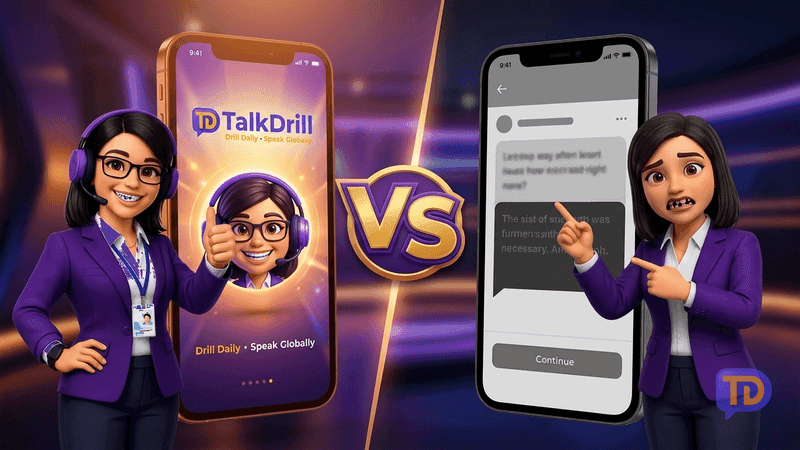
TalkDrill and FluentU represent opposing ends of the active-passive learning spectrum. TalkDrill is active — you produce language, speak into a microphone, and receive feedback on your output. FluentU is primarily passive — you watch and listen to authentic videos, absorbing vocabulary and patterns.
FluentU is genuinely excellent at what it does. This comparison will help you understand whether its strengths align with your specific learning goals — and whether its $29.99/month price tag is justified compared to TalkDrill Pro at $4.99/month.
What is TalkDrill?
TalkDrill is an English speaking practice platform on the web and Android, used by 30,000+ learners, where you have real-time spoken dialogues with AI tutors. You speak; the AI responds; you speak again. After the session, you get a scored report on your grammar, vocabulary usage, fluency, and pronunciation. Scenarios cover everything from casual conversation to job interviews and workplace discussions.
It is not only conversation. You can save new words to a Word Bank and review them as spaced-repetition flashcards, read 12 free English e-books, and play 20 free English games, including a Listening Quiz. Learn adds two short courses, English Grammar Basics and Everyday Spoken English.
The core value proposition: learning to speak by speaking. Daily AI conversation practice builds the mental agility and confidence needed for real-world English communication.
What is FluentU?
FluentU is a video-based language learning platform founded in 2011 that uses authentic real-world videos to teach languages. Its library includes movie clips, news broadcasts, YouTube videos, advertisements, and educational content — all with interactive subtitles.
How FluentU Works
You watch a video and interact with the subtitles. Click any word to see:
- Definition in plain English
- Pronunciation audio
- Example sentences from other videos
- Visual context from scenes where the word appears
After watching, you complete flashcard reviews. FluentU's algorithm tracks which words you know and schedules reviews using spaced repetition — maximizing long-term retention.
What FluentU Does Well
- Authentic content — real native speakers in real contexts, not scripted lessons
- Vocabulary in context — you see words used naturally, not in isolation
- Spaced repetition — smart review scheduling for maximum retention
- Listening comprehension — continuous exposure improves understanding
Feature-by-Feature Comparison
Speaking Practice
Winner: TalkDrill
TalkDrill is built for speaking. FluentU is built for watching. This difference is decisive if your primary goal is spoken English fluency. You cannot improve your speaking by watching others speak — you improve by speaking yourself, getting feedback, and improving. TalkDrill provides this. FluentU does not.
Vocabulary Building
Winner: FluentU
FluentU's combination of authentic video context and spaced repetition is genuinely excellent for vocabulary acquisition. Seeing words in real usage — in movies, news, conversations — creates richer memory associations than vocabulary drills. If building vocabulary is your priority, FluentU's approach is superior. TalkDrill's Word Bank also uses spaced-repetition review, but for words you save yourself, without video context.
Listening Comprehension
Winner: FluentU
FluentU's extensive library of authentic audio provides immersive listening practice that TalkDrill cannot match. TalkDrill's listening practice is lighter: you listen to the AI in every conversation, and its free games include a Listening Quiz, but there is no video library. For learners who struggle to understand fast native-speaker speech, FluentU's graduated video content is more targeted.
Interview Preparation
Winner: TalkDrill
TalkDrill has dedicated mock interview practice, including interviews built from a job description you paste. FluentU has none. End of comparison on this dimension.
Price
Winner: TalkDrill
TalkDrill Pro: $4.99/month. FluentU: $29.99/month. TalkDrill has a free plan. FluentU does not. At a much higher price for a platform that does not include speaking practice, FluentU is hard to justify for most learners.
Pricing Comparison
TalkDrill
- Free: about 2 minutes of AI voice a day, no trial limit; games and e-books are free
- Pro Monthly: $4.99/month (₹299 in India), about 30 minutes a day (around 2 hours a week)
- Pro Annual: $47.88/year (₹2,868 in India)
- Pro+: $9.99/month (₹799 in India), about 60 minutes a day plus 4 one-to-one human tutor sessions a month
FluentU
- Free: Trial only — no ongoing free access
- Monthly: $29.99/month
- Annual: $179.88/year
Pros and Cons
TalkDrill Pros
- Active speaking practice — you produce language every session
- Dedicated interview preparation AI coaches
- Immediate feedback on grammar, vocabulary, fluency, pronunciation
- Far cheaper than FluentU
- Small free plan, plus 20 free games and 12 free e-books
- Available 24/7 without scheduling
TalkDrill Cons
- No authentic video content for cultural exposure
- Less systematic vocabulary-in-context building
- Less developed listening comprehension training
FluentU Pros
- Authentic native-speaker video content from real media
- Excellent vocabulary acquisition through contextual exposure
- Interactive subtitles make every video a learning opportunity
- Spaced repetition maximizes vocabulary retention
- Develops listening comprehension through volume and variety
- Engaging content that makes learning enjoyable
FluentU Cons
- Expensive — $29.99/month, no free tier
- Primarily passive — you watch, you do not speak
- No speaking practice or speaking feedback
- No interview preparation or professional English coaching
- Watching does not directly translate to speaking ability
Passive vs Active Learning: Why It Matters for Speaking
Understanding the active-passive distinction is key to choosing between TalkDrill and FluentU.
Passive learning (watching, listening, reading) builds your internal model of the language. You absorb vocabulary, grammar patterns, and natural rhythms. This is valuable — but it does not directly train your ability to produce language under pressure.
Active learning (speaking, writing) forces you to retrieve and use language in real time. This is what builds fluency — the ability to speak without translating, hesitating, or searching for words. Active practice under mild pressure (like a conversation where you must respond) produces the most significant speaking improvements.
Most English learners already get significant passive exposure through movies, YouTube, and work interactions. What they lack is active production practice — which TalkDrill directly provides.
The ideal combination: passive input (FluentU or similar) to build vocabulary and listening, plus active practice (TalkDrill) to convert that knowledge into fluent speech. If you must choose one, active practice produces more direct speaking improvement.
Who Should Use Each App?
Choose TalkDrill If You:
- Want to speak English more confidently in real situations
- Are preparing for job interviews in English
- Already have decent vocabulary but freeze when speaking
- Want maximum value — far cheaper than FluentU
- Practice actively rather than passively
Choose FluentU If You:
- Want to build vocabulary through authentic real-world content
- Need to improve listening comprehension of native-speed speech
- Enjoy learning through authentic media (movies, news, YouTube)
- Are an intermediate learner wanting richer language exposure
- Can afford $29.99/month for vocabulary and listening focus
Indian Learner Perspective
Indian learners often have significant passive English exposure — Bollywood films frequently mix English, English-language YouTube content is widely consumed, and many workplaces use English documentation. The gap is typically not vocabulary or listening — it is the confidence and ability to produce English spontaneously in speaking situations.
FluentU adds more passive input to a learner who may already have sufficient passive exposure. TalkDrill converts existing passive knowledge into active speaking ability — addressing the actual gap. For most Indian professionals, TalkDrill is the more targeted intervention.
AI-powered learning tools like TalkDrill represent the forefront of educational technology — companies like Softechinfra specialize in building such AI-driven educational platforms that make high-quality practice accessible and personalized for learners everywhere.
Our Verdict
For vocabulary and listening through authentic content: FluentU wins.
If you can afford only one app, choose based on your primary gap. Most Indian learners need speaking practice — TalkDrill is more directly useful at a fraction of the price. FluentU is excellent but expensive, and primarily develops passive skills that many Indian learners already have from their media environment.
The power combination: TalkDrill daily for active speaking practice + occasional FluentU for vocabulary and listening enrichment. But if budget forces a choice, TalkDrill delivers more speaking improvement per rupee.