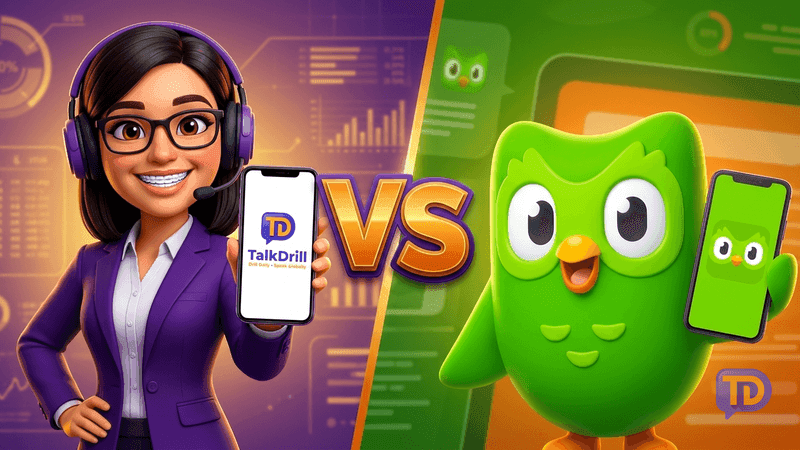

Duolingo vs ChatGPT: A Fair Fight?
Comparing Duolingo and ChatGPT for English learning is a bit unusual — one is a dedicated language learning app designed specifically for education, the other is a general-purpose AI assistant repurposed by learners as an English tutor. But this comparison is increasingly relevant as more people discover that ChatGPT can be a powerful, free English learning tool.
The honest answer: you don't have to choose. Both tools are free (at their base tier), they complement each other, and using them together is smarter than picking one. But understanding what each does well will help you use both more effectively.
What is Duolingo?
Duolingo is one of the world's most downloaded education apps — about 140 million monthly active users in Q2 2026, available in 40+ languages, and free to use for the complete course. Its core insight: consistency beats intensity in language learning, and gamification is the most reliable way to build consistency.
How Duolingo Teaches English
Duolingo's English course takes you from absolute beginner (A1) to upper-intermediate (B2) through:
- Bite-sized lessons (5–15 minutes) mixing vocabulary, grammar, listening, and speaking exercises
- Contextual vocabulary introduced through themed units (family, food, travel, work)
- Grammar tips explaining patterns before exercises
- Stories — interactive reading comprehension with native audio
- Podcasts — authentic English audio for advanced listening
The Gamification Engine
Duolingo's streak counter, XP system, weekly leagues, and achievement badges create genuine psychological commitment to daily practice. Losing a 50-day streak hurts. This is by design — and it works. Users practice more consistently on Duolingo than on virtually any comparable app.
What is ChatGPT for English Learning?
ChatGPT was not designed for language learning — but its capabilities make it remarkable for many English learning use cases. Learners worldwide have discovered creative ways to use it as a grammar tutor, writing coach, vocabulary explainer, and conversation partner.
ChatGPT for Text-Based English Practice
In text mode, ChatGPT is exceptionally useful for:
- Grammar questions: "When do I use 'will' vs 'going to'?" — detailed, accurate answers
- Writing correction: Paste a paragraph and ask for corrections with explanations
- Vocabulary in context: "Give me 5 ways to say 'I understand' in professional English"
- Error pattern diagnosis: Describe your errors and get targeted advice
- Interview practice: "Act as an HR interviewer and ask me questions for a software engineer role"
ChatGPT Voice Mode for Speaking Practice
ChatGPT's voice mode enables natural spoken English conversations. The AI responds with remarkably human-like cadence and vocabulary. This is genuinely useful for building speaking fluency — the limitation is that it provides zero feedback on pronunciation or grammar unless you specifically ask.
Feature-by-Feature Comparison
Structure and Progression
Winner: Duolingo
Duolingo has a clear A1–B2 progression. You know exactly where you are, what you've mastered, and what comes next. ChatGPT is a blank slate — enormously powerful but requiring significant self-direction. For learners who don't know what to study, Duolingo's structure is invaluable. For learners who know exactly what they need to work on, ChatGPT's flexibility may be preferred.
Grammar Depth
Winner: ChatGPT — significantly
Duolingo provides basic grammar tips before lessons, using an implicit approach where you learn by doing. ChatGPT can answer any grammar question at any depth, provide multiple examples, explain exceptions, and tailor explanations to your level and native language background. For grammar clarification, ChatGPT is in a different class.
Speaking Practice
Winner: ChatGPT (voice mode)
Duolingo's standard speaking feature asks you to read scripted sentences aloud (its AI Video Call needs the pricier Max tier). ChatGPT voice mode lets you have genuine, unpredictable conversations. The difference between reading a script and generating your own sentences in real time is enormous — the latter is what builds actual speaking fluency.
Habit Formation
Winner: Duolingo — significantly
Duolingo's gamification system is one of the most effective habit formation tools in consumer tech. ChatGPT has no streaks, no reminders, no progression system. If you need external motivation to practice consistently — and most learners do — Duolingo is dramatically better at keeping you engaged.
Vocabulary Building
Winner: ChatGPT (depth), Duolingo (systematic coverage)
Duolingo systematically introduces vocabulary through themed units with spaced repetition. ChatGPT provides richer, more nuanced vocabulary explanation when asked but doesn't proactively introduce new words. Use Duolingo for systematic vocabulary building; use ChatGPT for deep understanding of specific words and phrases.
Grammar and Vocabulary: Which Teaches Better?
For grammar, the honest assessment: ChatGPT is a better grammar teacher than Duolingo. When you ask ChatGPT "Why is this sentence wrong?" or "What's the difference between 'affect' and 'effect'?", you get a comprehensive, accurate, and nuanced answer. Duolingo either implicitly teaches grammar or provides brief tips that often leave learners with unanswered questions.
For vocabulary, Duolingo wins for systematic coverage. Its themed units and spaced repetition review ensure you build a comprehensive vocabulary across topics. ChatGPT expands vocabulary depth when you use it actively, but won't proactively introduce the words you need to know.
The optimal combination: use Duolingo's vocabulary units daily, and use ChatGPT whenever you hit a grammar question that Duolingo doesn't fully answer.
Speaking Practice: The Real Difference
This is where the choice matters most for most learners. On the free and Super plans, Duolingo's speaking practice is fundamentally limited — you read scripted sentences aloud and get a pass/fail pronunciation check. Duolingo Max adds an AI Video Call, but at a higher price. There is no spontaneous dialogue, no opportunity to form your own sentences under time pressure, and no feedback on whether your response was coherent or appropriate.
ChatGPT voice mode enables real conversation practice — flowing dialogues where you must think and respond in English. This builds the mental habit of thinking in English that scripted exercises cannot. The limitation is no pronunciation or grammar feedback during the conversation.
For Indian learners who already understand English grammar but struggle to speak spontaneously, ChatGPT voice mode is more valuable than Duolingo's speaking feature.
Our Verdict
Use ChatGPT for: Grammar questions, writing correction, vocabulary depth, conversation practice (voice mode), and flexible self-directed learning.
Together, they're free and comprehensive — more complete than either alone.
The frame of "Duolingo vs ChatGPT" is misleading — these tools work far better as complements than competitors. Duolingo keeps you consistent with daily structured practice. ChatGPT deepens your understanding and provides conversational practice when you need it. Using both free tiers together gives you arguably the best free English learning stack available in 2026.
Looking for Something Different?
Both Duolingo and ChatGPT have a shared limitation for speaking improvement: neither provides structured, feedback-rich speaking practice. Duolingo's scripted exercises don't build spontaneous speech. ChatGPT voice mode builds fluency but provides no feedback on your grammar or pronunciation errors.
This is where TalkDrill adds the missing piece. Used by 30,000+ learners, TalkDrill provides natural AI voice conversations — like ChatGPT voice mode — plus automatic post-conversation feedback on grammar accuracy, vocabulary range, pronunciation, and fluency. It also has text chat with an AI tutor (replies can be translated into Hindi and nine other Indian languages), mock interviews and role-plays with a scored report, and two short Learn courses for grammar and everyday spoken English. It specifically targets the gap between knowing English and being able to speak it fluently under real-world conditions.
The optimal free stack: Duolingo (structure + habits) + ChatGPT (grammar + depth) + TalkDrill (speaking practice + feedback). Duolingo's and ChatGPT's free tiers are generous; TalkDrill's is a small daily taster (about 2 minutes of AI voice a day, plus free games and e-books), and Pro is ₹299 ($4.99) a month. This combination addresses vocabulary, grammar, and speaking fluency more comprehensively than most paid courses, at little or no cost. Students who want to add writing improvement can supplement with PenLeap's AI writing feedback tools.