
Quick Overview: Duolingo vs Babbel for English
Duolingo and Babbel represent two very different philosophies about how people learn languages. Duolingo bets on gamification and habit formation — making daily practice so fun and rewarding that you keep coming back. Babbel bets on curriculum quality and real-world relevance — teaching you the exact phrases and structures you will actually use in conversations.
If budget is your primary constraint, Duolingo wins by default — its free tier is genuinely usable. If you are willing to pay and want better content quality, Babbel offers a meaningfully different experience. Let's break down every relevant factor.
What is Duolingo?
Duolingo is one of the world's most downloaded language learning apps, launched in 2011 and reporting about 140 million monthly active users in 2026 (Q2 2026 shareholder letter). Its defining feature is radical accessibility — the full English course is available for free, and the app is designed to be so engaging that you voluntarily return every day.
The Gamification Engine
Duolingo pioneered language learning gamification:
- Daily streaks — consecutive days of practice tracked with visual fire
- XP points — experience points earned per lesson
- Leagues — weekly competitions where you race to earn more XP than other learners
- Hearts (lives) — limit mistakes per session, adding pressure and focus
- Achievement badges — celebrating milestones and consistency
The Duo owl mascot's persistent notifications have become an internet meme. But the gamification works — Duolingo reported about 58.7 million daily active users in Q2 2026, a scale few educational apps come close to.
English Course Scope
Duolingo's English course covers beginner to upper-intermediate (A1–B2) with lessons on vocabulary, grammar, listening comprehension, and basic speaking. It also offers Stories (short interactive narratives), Podcasts (authentic audio for advanced learners), and the Duolingo English Test (DET) — an accepted alternative to IELTS at 3,000+ institutions.
What is Babbel?
Babbel, founded in Germany in 2007, takes a different approach: substance over style. Rather than gaming mechanics, Babbel invests in content quality — lessons built by a team of over 100 linguistic experts, speech therapists, and native speakers. The result is a more mature, practical learning experience.
The Babbel Method
Babbel's lessons are built around practical conversation scenarios — ordering food, navigating airports, workplace small talk, discussing current events. Each lesson:
- Introduces vocabulary in context, not in isolation
- Explains grammar rules explicitly before applying them
- Includes dialogue practice where you fill in your side of a conversation
- Uses spaced repetition review to reinforce what you've learned
- Provides pronunciation exercises with speech recognition feedback
Content Depth
A single Babbel course contains 40–60 hours of content. The English course spans beginner to advanced, with specialized content for business English, travel, culture, and podcasts for advanced listening. The content is noticeably higher quality than Duolingo — fewer errors, more natural phrasing, and exercises that feel purposeful rather than game-like.
Feature-by-Feature Comparison
Cost and Accessibility
Winner: Duolingo
This is Duolingo's defining advantage. The complete English course is free with ads. For learners in developing markets — including India, where many learners cannot justify spending on language apps — this is not a minor point. It is the difference between access and no access.
Babbel requires a subscription after the first lesson preview. There is no meaningful free tier. At similar annual pricing ($83.40/yr vs $83.99/yr), the paid tiers are comparable — but Duolingo free is dramatically better than Babbel free (which barely exists).
Content Quality and Depth
Winner: Babbel
Babbel's content is more carefully crafted. Lessons teach practical phrases you will actually use, grammar explanations are clearer, and the dialogue-based exercises feel more purposeful. Duolingo's content is occasionally inconsistent, includes some awkward sentences ("The elephant drinks juice"), and can feel disconnected from real-world usage at times. For serious learners who want high-quality content, Babbel is worth the premium.
Habit Formation
Winner: Duolingo
Duolingo's gamification is genuinely effective at building daily learning habits. The streak counter creates a powerful psychological commitment device — losing a 60-day streak feels genuinely painful. Babbel has no equivalent mechanism; it relies on your intrinsic motivation. Research consistently shows that consistency matters more than lesson quality. If Duolingo keeps you practicing daily while Babbel doesn't, Duolingo produces better outcomes despite its content limitations.
Speaking Practice
Winner: Babbel (marginally)
Babbel's speaking exercises are dialogue-based — you participate in conversations, reading your side of exchanges. This creates slightly more natural speaking practice than Duolingo's mostly read-aloud prompts. However, on their standard plans neither app provides anything close to spontaneous conversation practice; Duolingo's AI Video Call is reserved for the pricier Max tier. Both standard courses use scripted exercises that remove the cognitive challenge of forming your own sentences in real time.
Grammar Instruction
Winner: Babbel
Babbel wins clearly here. Its grammar notes are explicit, detailed, and clearly explained before exercises. Duolingo uses an implicit, inductive approach — you're supposed to figure out grammar patterns from examples. This works for some learners but leaves many confused about why certain rules apply. For Indian learners who studied English grammar in school and want clear reinforcement, Babbel's explicit approach is much better.
Pricing: The Key Numbers
| Plan | Duolingo | Babbel |
|---|---|---|
| Free | Full course (ads + hearts) | 1 preview lesson only |
| Monthly | $12.99/mo | $12.95/mo |
| Annual | $83.99/yr ($6.99/mo) | $83.40/yr ($6.95/mo) |
The pricing is nearly identical at the paid tier. The real difference is the free tier: Duolingo free covers the entire course, while Babbel free is a single preview lesson.
Who Should Use Each App?
Choose Duolingo If You:
- Cannot or don't want to pay for a language app
- Struggle with building daily practice habits — the streak system helps
- Are a complete beginner who needs gentle onboarding
- Want to learn multiple languages beyond English
- Are motivated by competition and social features (leagues)
Choose Babbel If You:
- Are willing to pay for better content quality
- Want to learn practical, conversational English from the start
- Are an intermediate learner who has outgrown Duolingo's content
- Prefer clear grammar explanations over implicit pattern learning
- Learn better through structured, adult curriculum than games
Our Verdict
Paying learners: Babbel is marginally better for content quality and practical focus, but the difference is smaller than you might expect at identical pricing.
Speaking fluency: Neither app's standard plan delivers real conversational practice (Duolingo Max's AI Video Call costs extra). Both need to be supplemented.
The most important thing to understand about both apps: they teach you about English — grammar rules, vocabulary lists, structured exercises. They do not train you to speak English fluently in spontaneous conversations. Most Indian learners already have "school English" knowledge that matches what these apps teach. What they lack is speaking confidence and conversational agility — which requires a different kind of practice.
Looking for Something Different?
If your goal is to speak English confidently — in interviews, at work, or in social situations — Duolingo and Babbel are not the right primary tools. They are vocabulary and grammar builders, not speaking trainers.
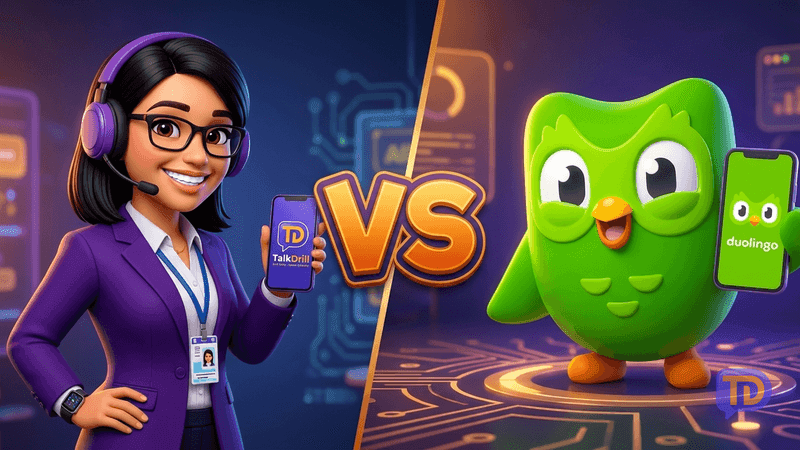
For English speaking practice, consider TalkDrill — an AI-powered conversation practice app where you have real voice conversations with AI tutors. Unlike Duolingo and Babbel's scripted exercises, TalkDrill engages you in spontaneous dialogues — exactly the kind of practice that builds real-world speaking confidence.
Used by 30,000+ learners, TalkDrill also has a little of what Duolingo and Babbel do: two short Learn courses (English Grammar Basics and Everyday Spoken English) whose chapters end with you saying the sentence out loud, a practice streak, and 20 free English games with a weekly leaderboard. They are lighter than either app's full course, which is why the pairing below still makes sense.
A powerful combination for English learners: use Duolingo (free) for vocabulary and grammar + TalkDrill for speaking practice. This dual approach addresses both knowledge gaps and skill gaps at minimal cost. Students looking to strengthen their writing alongside speaking can explore AI writing tools like PenLeap for grammar improvement and writing feedback.